

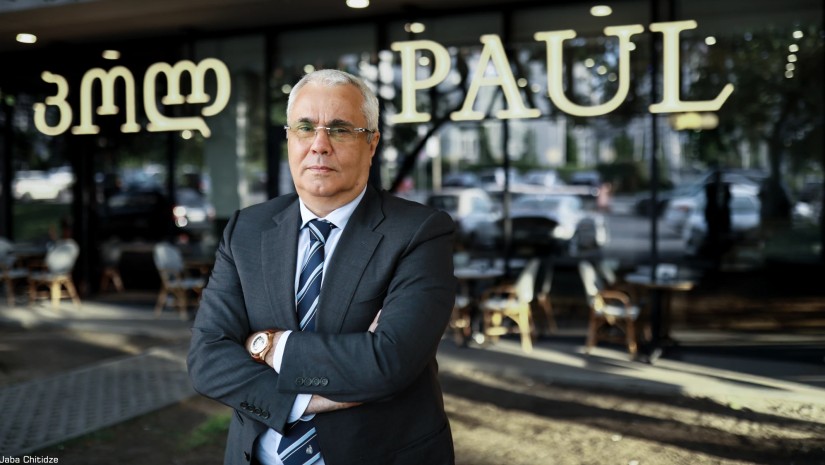

From transforming ports and launching landmark developments to introducing global brands and shaping new hospitality ventures, Zaza (Gela) Mikadze reflects on a career defined by ambition, innovation, and a willingness to take on unfamiliar challenges.
For more than three decades, Zaza Mikadze has been involved in some of Georgia’s most significant business and infrastructure projects. His professional journey spans logistics, real estate, retail, hospitality, free industrial zones, and food and beverage operations. Today, as Chairman of the Supervisory Board of Global Lifestyle, he continues to pursue large-scale developments while reflecting on the experiences that shaped his approach to leadership and business. In this interview, Mr. Mikadze discusses the projects he is most proud of, the importance of professional teams, the lessons learned from success and failure, and his vision for the future.
Mr. Mikadze, your business activities span many industries. How would you describe your professional journey?
Today, I serve as Chairman of the Supervisory Board of Global Lifestyle. Looking back, my career has involved a wide variety of sectors and projects, many of which have played an important role in Georgia’s economic development.
One of the most significant periods of my career was my involvement with Poti Port between 2007 and 2011. During that time, we carried out a comprehensive modernization program. The port underwent a complete technological transformation. We replaced outdated Soviet-era equipment with modern German-manufactured Gottwald cranes and introduced digital technologies that had never before been used at the port.
When we assumed responsibility, the port was operating at a loss. Within only a few years, it became one of the most profitable companies in Georgia. More importantly, technologically it became one of the leading ports in the region.
Beyond the port itself, what other projects were developed during that period?
Several important projects emerged from that period. One was the Poti Customs Clearance Economic Zone (GEZ), which was developed entirely from concept to implementation with my direct involvement.
The site originally consisted of approximately ten hectares of marshland. Within a year, it was transformed into a fully operational logistics and customs terminal. The operating model, development concept, construction process and management framework were all created and implemented under my leadership.
Another major initiative was the Poti Free Industrial Zone (FIZ). The concept, structure and operational model were developed by my team in 2008.
We also initiated the construction of Poti International Airport. Unfortunately, despite substantial preparation and the commencement of construction works, the project was not completed. In my view, had it been realized, it would have become one of the most profitable infrastructure projects in western Georgia.
What initially attracted you to such large infrastructure projects?
To be honest, much of it happened organically. At the time, I was serving as CEO of a major company. International investors were actively exploring opportunities in Georgia and frequently encountered challenges in sectors that required restructuring or professional management. Whenever a difficult project emerged, I was often asked to become involved.
I was not a port specialist when I entered the sector. However, I believe success comes from assembling the right team, studying the subject thoroughly, listening to experts and making informed decisions.
The ability to listen is one of the most underrated leadership skills. I surrounded myself with professionals who possessed deep industry expertise, and together we achieved results that many considered impossible.
Another major project associated with your name is Tbilisi Mall. How did that come about?
Tbilisi Mall was one of the most ambitious developments of its time. In fact, the term "mall" itself was relatively unfamiliar in Georgia when I introduced the concept. Beyond the shopping center itself, the original master plan envisioned a much larger mixed-use development incorporating hospitality, residential and commercial components.
I was directly involved in securing financing, including support from the International Finance Corporation (IFC), which was instrumental in completing the project.
The construction itself was enormous in scale. Approximately 256,000 square meters were developed within a relatively short timeframe. At peak activity, the construction site employed between 3,000 and 4,000 workers daily. I was not only involved in development but also oversaw the construction company responsible for delivering the project.
You have also played a role in bringing international brands to Georgia.
Yes, several international retail and hospitality brands entered Georgia through relationships and initiatives that I helped facilitate. The Al Hokair Group entered the Georgian market through personal connections and introduced brands such as “Zara", “Massimo Dutti” and many others. Today, they represent one of the country's largest retail operators. Similarly, “Carrefour's” entry into Georgia was initiated through discussions involving senior executives, international partners and development institutions. It was a long process, but one that ultimately contributed to the modernization of the retail sector.
I was also involved in the early discussions surrounding “Starbucks”' future presence in Georgia. Those conversations began as early as 2011 through meetings directrly with Mr. Al Ahayaya.
Your interests later expanded into hospitality and food and beverage. How did that transition occur?
Interestingly, it happened almost by accident. During the development of Tbilisi Mall, we realized there was very little interest from established food and beverage operators. To help fill that gap, I introduced “Moka & More” and later developed a local concept called “Khachapuri Hut”. That experience sparked my interest in the sector.
The story of PAUL is particularly personal. In the 1990s, my sister was studying in Paris. During visits, I would often have breakfast at a PAUL café located near her residence. The brand left a lasting impression on me. Years later, when I decided to expand our food and beverage operations, PAUL immediately came to mind. We began discussions with the French company around 2014–2015 and eventually secured the franchise rights.
Today, the brand operates very successfully in Georgia.
Your hospitality portfolio also includes hotels.
Yes. Hospitality remains one of our strategic priorities. Our group currently operates the Golden Tulip hotel in Borjomi and owns another hospitality asset in Tskaltubo.
The introduction of the Golden Tulip brand to Georgia was made possible through long-standing professional relationships and cooperation with international partners. Since then, the brand has expanded its presence in the country.
Hospitality is a sector I find particularly rewarding because it combines development, service, culture and tourism into a single experience.
Before entering business, your professional background was actually in law. Tell us about that period.
I graduated from Tbilisi State University with a degree in Economics and later completed a degree in Law. My legal specialization was intellectual property. I also completed professional training in the United States at the “Baker Botts” LLP, one of the leading international law firms. During the 1990s, I built one of Georgia's leading intellectual property firms. At a relatively young age, I became President of the Georgian Patent Attorneys Association. Eventually, our company established representation across all former Soviet republics.
In 2006, however, I decided to leave active legal practice after receiving an offer to join a major investment group. I surrendered my professional license and shifted my focus entirely to business management and investment. That decision changed the course of my career.
How would you describe your leadership philosophy?
Everything begins with people. The most important task for any leader is building the right team. I strongly believe that professional expertise should always take precedence over personal relationships. One of the mistakes many organizations make is hiring familiar faces instead of qualified specialists. In my experience, this often creates long-term problems.
A successful leader must listen carefully, evaluate different perspectives and make informed decisions. No individual can know everything. Experience, teamwork and continuous learning are essential.
As I often say, experience remains life's greatest teacher. Universities provide knowledge, but real understanding comes from practice, mistakes and perseverance.
Looking back, do you consider yourself a successful businessman?
Absolutely. I believe the results speak for themselves. Most of the projects I have been involved in achieved strong commercial success and created lasting value.
At the same time, there are projects that never reached completion, and those remain a source of disappointment. Some concepts that we developed nearly twenty years ago are only now being implemented by others. Nevertheless, I am proud of what has been accomplished and grateful for the opportunities I have had to contribute to Georgia's development.
What projects are currently occupying your attention?
One of our most exciting projects is the restoration and redevelopment of the historic Hotel Metallurgi in Tskaltubo. Our goal is to transform the property into a luxury five-star hotel with approximately 120 rooms. Design work is currently underway, and we are targeting an opening in 2029.
Finally, after everything you have achieved, what continues to motivate you?
I still enjoy creating something new. Every successful project begins with an idea, a vision and a team willing to make it happen. That process remains as exciting today as it was twenty years ago. The scale may change, industries may change, but the motivation remains the same: building projects that create value, contribute to the economy and leave a lasting impact. That challenge continues to inspire me every day.