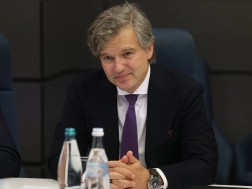


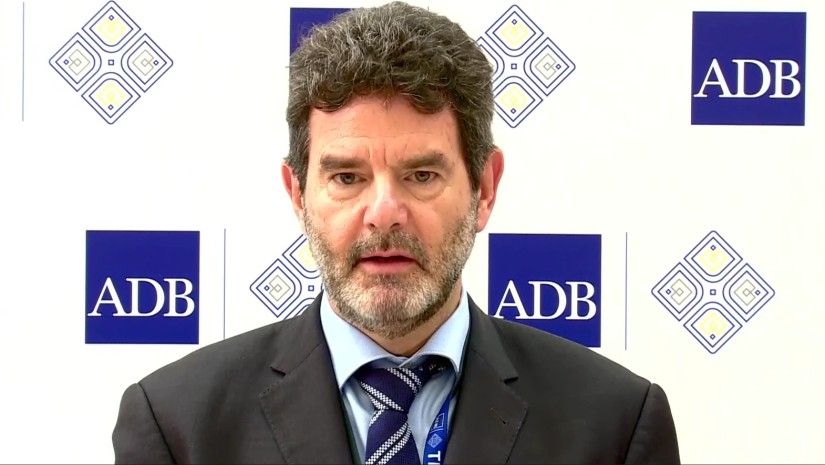

The European Bank for Reconstruction and Development’s (EBRD) Regional Director for the Caucasus, Alkis Vryenios Drakinos, says they plan to support Georgia’s private sector with 300 million euros. He made this comment in response to a journalist’s question about how Georgia’s paused EU integration process might affect Georgia–EBRD relations and lending activities.
“We are very committed to continuing to support Georgia’s private sector and the country’s development. For example, this year in Georgia we plan to invest more than 300 million euros across various sectors, banks, and small and medium-sized enterprises. So, we are quite active.
At this stage, we are focusing on developing and monitoring existing projects. We have priorities, and accordingly, we are observing where and what we can do. Therefore, we will continue studying and developing projects of regional importance,” Drakinos said.
“It is a great honor and privilege for me to participate in today’s annual Black Sea meeting, which is dedicated to the ‘Middle Corridor.’ The ‘Middle Corridor’ is a very important concept and initiative, and Georgia is located at its center. The whole Caucasus must play a decisive role in connecting Asia and Europe, and the EBRD is very interested in being involved in all processes, discussions, and project research stages — so that we can assess how to make the Middle Corridor a real and viable route connecting Europe and Asia.
We are already actively working in all countries that make up part of the Middle Corridor, from Central Asia through the Caucasus. Speaking of Georgia specifically, we already have investments in railway and road projects,” he stated.
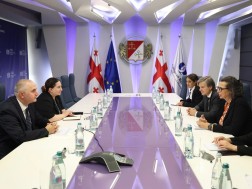
Today, on November 20, the annual Black Sea Platform conference is being held, organized by the EU–Georgia Business Council (EUGBC) with the support of the German Society for International Cooperation (GIZ).
As part of the conference, participants will discuss the challenges and opportunities related to the effective functioning of the Middle Corridor transport route. Special emphasis will be placed on specific infrastructure projects and reforms that will facilitate trade with the European Union through the Black Sea and strengthen regional connectivity.
The event is attended by around 150 representatives of the diplomatic corps accredited in Georgia, business associations, the private sector, and civil society organizations from Georgia, the European Union, Azerbaijan, Armenia, and Central Asian countries.