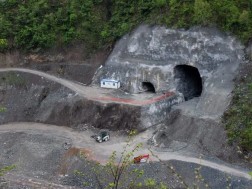


Georgia faces a significant financial blow following its loss in international arbitration against Turkish investor ENKA, the developer behind the canceled Namakhvani Hydropower Plant (HPP) project. The country has been ordered to pay USD 450 million in compensation, a figure that could rise further due to an additional penalty of 4% interest, plus the U.S. Federal Reserve's monetary policy rate.
The dispute stems from the Georgian government’s unilateral termination of the Namakhvani contract, a decision announced in June 2021 by then-Prime Minister Irakli Gharibashvili, who said the HPP project would no longer continue in its current form due to “unacceptable” contract terms. ENKA subsequently filed an arbitration claim, citing violation of its investment rights.
Although there were attempts to resolve the issue through negotiations, they ultimately failed. Merab Lominadze, former director of ENKA in Georgia, noted that miscommunication and the rigidity of legal positions on both sides made a compromise unattainable.
“Consultations were held, but the investor saw its legal position as strong and maintained a firm stance,” said Lominadze.
The project, valued at USD 800 million, was planned to be commissioned in 2025–2026 and would have become the second-largest HPP in Georgia after Enguri, with an estimated annual output of 1.5 billion kWh, over 10% of the country’s projected electricity production in 2024.
Now, not only has Georgia lost the chance to attract one of the largest energy investments in its history, but it may also owe more than half a billion dollars, depending on final interest calculations.
“This matter should never have reached arbitration,” said energy expert Murman Margvelashvili. “We lost a potential USD 800 million investment and now owe USD 450 million, making the real loss over USD 1.25 billion. If you divide that among the population, it’s about USD 320 per person.”
Beyond the financial damage, Margvelashvili emphasized the energy sector consequences. The Namakhvani HPP was designed as a reservoir-based facility, capable of producing electricity in winter, a critical need for the country's energy security.
Others worry about the reputational fallout. Maia Melikidze, Executive Director of the Renewable Energy Development Association, argues that the case has deeply damaged Georgia’s credibility as an investment destination.
“It’s a serious blow—not just financially, but also in terms of future investor interest. Why would any serious investor engage with us after this?” she said.
The Namakhvani project had been highly controversial from the start. It sparked mass protests in the Rioni Valley, Kutaisi, and Tbilisi, with environmentalists and civil activists accusing the government of handing over valuable land and water resources to foreign investors with minimal transparency and unclear national benefits.
Critics particularly objected to a clause in the agreement requiring the state to purchase electricity generated by the plant for the first 15 years, excluding May and summer months, when Georgia already has an electricity surplus and even exports energy.
As political tensions rose, the ruling Georgian Dream party began shifting blame. While Gharibashvili called the contract unacceptable, current Prime Minister Irakli Kobakhidze claimed in late 2023 that the ENKA contract was entirely valid, blaming non-governmental organizations (NGOs) and “anti-investment campaigns” for derailing the project.
On June 27, Kobakhidze unveiled a new hydropower development strategy in Parliament, pledging to increase national generation capacity from 4,000 to 10,000 megawatts by 2030, insisting that such growth cannot happen without the construction of new hydroelectric plants.