
More than 5000 employers and 60 000 employees have joined the e-system during the accounting period and total participants constitute 1 ml. 200 thousand persons. As to the outcomes, as of June 30, 2021, the number of persons in the system constituted 166 thousand 737, and the total funds constituted 1 bl. 550 ml. 400 k. GEL, including the accrued interest – 173 ml. GEL.
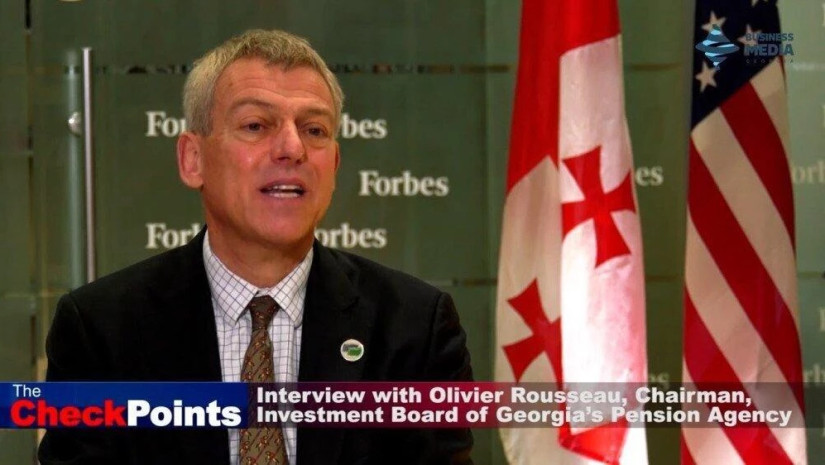
More is in our exclusive interview with Olivier Rousseau, Chairman of the Investment Board of Georgia’s Pension Agency.
Let’s start from the social and economic benefits of pension reform.
We see the pension reform as a very critical one in this country, in every country actually. It’s a very defining feature of an economy and a society what the pension arrangements are. In countries that are becoming efficient economies like Georgia you have to have an arrangement for pensions. The there are political choices to be made – it’s not in our constituency for us – the investment board members to decide what is politically wrong or right. What we can say is we see a very coherent institution that has been put in place by the law. It means first of all people will have better security for the time when they get old. They will have a better guarantee for having resources to support themselves.
It has also a lot of consequences on the way the economy functions. It means you have more capital available with two great virtues: patience and competency. When individuals think of their old days and they should and they save by themselves that is something good, but when the money is managed by specialists they have competencies and investment opportunities available to them which are much broader and cheeper to implement than when it is you or I investing personally.
So, that is very crucial.
Since you have been searving French pension agency as well for years, what could be some of the similarities and differences in investment strategies in the EU and for example in Georgia, which is an emerging economy?
In Georgia the big difference is the set of available investment opportunities is much narrower. We are working towards broadening the set of investment opportunities. It is very pleasant element of this visit of the investment board that we see there is a very broad support for the concept of broadening the set of available investment opportunities for the pension agency.
The supervisory board – the Ministries and the Chairwoman of the Supervisory Board seem to be very much on the same page with us. The same with the National Bank of Georgia (NBG). The same with the Parliament.
We had a meeting with the Chair of the Commission for the Budget and Financial Affairs and it all seems very aligned. This is very important, and I have to say to us it is we see an evolution – two years ago, the approach was not quite the same so things have moved very much in the right direction in our opinion because we said it from the start that over time we would need to have access to more asset classes. And now the mentality in the society and the reflection in the authorities around the pension agency have evolved.
That was exactly my question what makes you think that this is the right time to request more aggressive investment because at this point what the regulator has been saying basically was that pension agency should invest in less risky assets. What makes you think that it is time to step up for more aggressive investment strategy?
Actually, I am not necessarily saying that.
That’s interesting.
Not necessarily. So, your question is right. My answer will be a bit different from what you expected in the tone of your question.
What we are saying is within the same very tight risk parameters of the low risk portfolio which is the only one authorized by the law for another two years – we can actually implement the risk appetite which is limited more efficiently if we have access to more asset classes. We can invest in equities, yes – 20% maximum. But implementing investment in equities they can be done these investments by buying listed equities. They can also be done by buying unlisted equities, and the risk in buying in listed equities is not necessarily inferior to the risk involved in buying the private equity. And as long as – which is the case for the pension agency – you have a very long term investment horizon then you are able to capture the added returns provided by unlisted equities, because there is an ilequidity premium.
The same exactly can be said for private debt. We can take a lot of fixed income debt securities risks but debt security risk can be implemented by buying listed bonds or certificates of deposits, it can also be implemented by buying unlisted assets. So, same type of risk, but an implementation which gives more diversification and which can give an ilequidity premium.
The same reasoning can apply to other type of asset classes which today are not allowed in the low risk portfolio – investing in infrastructure projects, investing in real estate projects – these are not asset classes currently allowed under the low risk portfolio. It’s not additional risk but these are risks that you can combine in a different way and broaden the entities which should take the risk.
All that means you can have a better portfolio for the same amount of risk acceptable and utilize the potential to invest for the long term not having need to be ilequid for all the portfolio.
What could be the major challenge to this strategy that you are now talking about. What could go wrong?
From the discussions we have had, there is very broad common understanding that these are the desirable evolutions. Now we have the right in the law on pensions to make proposals to suggest changes which we are doing informally at this stage and we will do in a formalized manner very soon.
Initially it has to be a dialogue. It would be very wrong on our part, I think to discuss among ourselves – just investment board – and say this is what we think is desirable and we send the letter. That would not be the way.
So, we discussed among ourselves, then we exchange the views with all the interested parties – that is the supervisory board, that is the National Bank of Georgia, that is the Parliament and having exchanged views and taken into account very good remarks we are able to put together a proposal which will be a good one, I think.
What could go wrong? Not much in my opinion because we are building a consensus. It’s been a matter of confidence building. It has been clear that the investment board has remained very involved despite the difficulties of the COVID. It has been clear that we’ve been able to achieve very important milestones such as the appointment on specialized depository and the adoption of a full-fledged investment policy document which the National Bank of Georgia told us in writing is compatible with the law as is the duty of the National Bank of Georgia as our supervisor. So, we have reached very important milestones here.
This has created progressively more trust among all the interested parties. I think also the fact that we have been advocating for these evolutions has had an impact and I’m sure the interested parties that I mentioned before – they have contact with other very good providers of advice. They discuss with World Bank, they discuss with the IMF, they discuss with other pension funds. For example, in Armenia there is quite a different one from the solution in Georgia. This offers the opportunity for good discussions, for good exchanges.
You mentioned different stakeholders – the IMF, World Bank, EBRD and others – and one of the main virtues of this reform as stated by officials and by these partners was that this long-term Lari should have helped to build local capital markets and there was this kind of direct link between building the pension reform and developing capital markets – do you see this direct link there?
Absolutely. Our first mission is to build within the available risk and other constraints allowed by the law and regulation the best possible portfolio for our participants. For each category or amount of risk tolerable, we need to do our best to have the best return.
Building the capital markets in Georgia is not our first target. But it’s a logical implication.
I’m listening to you and all these changes to the investment strategy that you are negotiating with different stakeholders among the government and regulator stem also from the underdeveloped local capital markets as well, right?
Absolutely. Again, get me right. It’s not our fundamental objective by the law to develop the Georgian capital markets but it’s a logical necessary implication: To better serve the participants, we need more instruments in which to invest and that is exactly developing capital markets. I particular, we as the Pension Agency being able to invest in long-term Lari financings we will make a huge change to the capital markets in Georgia.
We have the investment horizon long enough to do that. We have the competency to analyze investment opportunities, and all it takes is say a few twicks in few limits that apply today. I will not go into detail here but by changing a few limits we will be much abler to deploy long-term capital in Lari and that will have a big impact on the economy.
We are talking here about the long-term investment but former Head of the Pension Agency stated that for year or more the inflation will be still eating up some of our savings – what is the strategy there to hedge inflation?
All of that is essentially correct. Yes, there is a spike in inflation. But our analysis is it will not last very long. The inflation rate will come down and during the time that the inflation rate has increased – of course, the real return shown by our investments has been less favorable but it is still a good one. But it has become less favorable. Absolutely.
But what we have in the portfolio is essentially nominal returns on the medium-term. When the inflation comes down then the difference between the nominal returns and the inflation rate will increase very significantly. Reading the real returns over one month or couple of quarters horizon is not the way we should do it.
And also to tie this picture into the more global picture – I would like to hear some outlook of global investment climate and what are some challenges and opportunities there?
It’s a good question because it is difficult to answer for me. But let me start by saying that we are very grateful to the national bank of Georgia for the flexibility they have shown in the early stages of our investments because as long as we didn’t have the investment policy document fully in place and the specialized depository in place an interpretation of the law could have been – well, all the pension contributions collected by the pension agency cannot be invested; they have to stay on current accounts. And then all we could have been doing would have been to to negotiate with each bank appropriate rates, which by the way the team has been doing.
But what the Central Bank allowed us to do was to deploy the money collected from the contributions into medium-term money with the banks. We think markets are exensive in general, the world over. We would have liked to see cheaper markets to invest in and as a consequence of our judgement that markets are expensive – equity markets in particular – we will not plan to invest in just one big chunk we will do that progressively.
We think this is a prudent way to implement the allocation. But there is also something which can help us despite the fact that the markets are expensive – this is the diversification we were speaking about before.
Are you seeking this diversification also abroad because we know that there is a 20% limit – are you negotiating to expand that threshold as well?
I think diversification for us its mostly in the Georgian economy. Post-COVID situation – our assessment is there are very good opportunities to deploy capital in the economy of Georgia. There always were good opportunities but there are even more opportunities now.