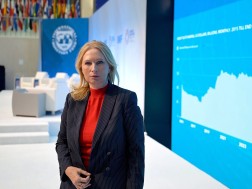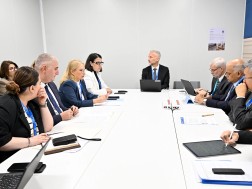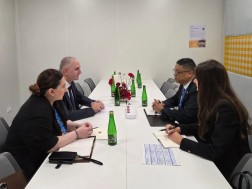


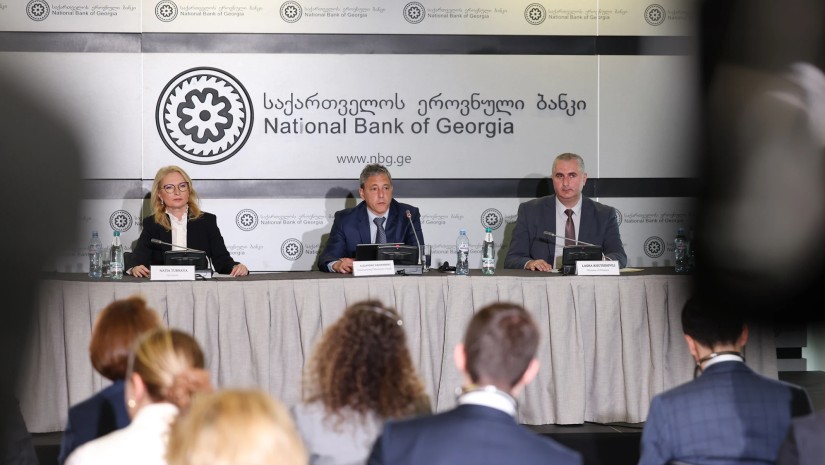

The International Monetary Fund (IMF) team has published conclusory statement on the results of its visit to Georgia, held during December 10-16. The IMF team met with representatives of the Government of Georgia and the National Bank of Georgia, and today, a final meeting was held with Finance Minister Lasha Khutsishvili and NBG President Natia Turnava. According to the head of the mission, Mr. Alejandro Heidenberg, high economic growth will be sustained in Georgia, but inflation has accelerarted recently, requiring the NBG be read to tighten the policy stance. Alejandro Hajdenberg notes that if the inflation rate increases, the National Bank should also be prepared to raise the refinancing rate.
Regarding foreign direct investment, the head of the IMF mission notes that strained relations with the European Union could negatively affect FDI, as they could directly impact investor confidence, However, on the other hand, Haydenberg points out that if the $6.5 billion in FDI from the Emirates does indeed get implemented, it will have a positive impact on the country's economic activity. Among other factors, The IMF points to the continuation of state-owned enterprise reform, as well as the purchase of foreign currency reserves by the National Bank, as a result of which Georgia's foreign exchange reserves will no longer fall below the threshold defined by IMF methodology. Hajdenberg also discusses the National Bank's decision-making process, noting that it is important to implement legislative changes that would establish a decision-making process within the NBG. Heidberg also speaks on the National Bank's decision-making process, noting that it is important to implement legislative changes, which would replace the presidential decision-making model at the NBG with a collegial decision-making model.
“The Georgian economy continues to perform well. Real GDP is expected to grow by 7.3 percent in 2025, a deceleration from last year but high by historical standards. Economic activity has been led by the information technology, transport, and education sectors, which have expanded rapidly post pandemic and since the start of the war in Ukraine. Rapid growth has led to a decline in the unemployment rate to a record low of 13.3 percent, though it remains structurally elevated.
“Inflation accelerated in 2025 and stood at 4.8 percent year-on-year in November, above the 3 percent target of the National Bank of Georgia (NBG). The increase was driven mainly by domestic food prices, and is expected to be transitory. Core inflation remains below target, suggesting an absence of broad-based price pressures. The NBG has appropriately maintained a cautious monetary policy stance, keeping its policy rate unchanged at 8 percent. Nevertheless, if inflation proves more persistent than is currently anticipated, the NBG should stand ready to tighten the policy stance.
“Gross international reserves have increased markedly, rising to a historical high of USD 5.8 billion in November from last year’s low of USD 4.1 billion, reaching around 100 percent of the IMF’s Assessing Reserve Adequacy (ARA) metric. The improvement reflects a resumption of deposit de-dollarization and strong current account inflows boosted by robust services exports and remittances, which have allowed the NBG to step up foreign exchange purchases, as well as higher gold prices. If market conditions allow, further accumulation of reserves is desirable.
“Fiscal policy remains disciplined. The budget deficit in 2025 is expected to remain below the original target of 2.5 percent of GDP, reflecting strong revenue alongside the under-execution of planned capital spending. The 2026 budget prudently targets a deficit of 2.5 percent of GDP, envisaging a recovery in public investment and increased social spending. The USD 500 million Eurobond maturing in April 2026 is expected to be rolled over smoothly under current market conditions. Looking forward, there is scope to mobilize more revenue by expanding the tax base and streamlining tax expenditures, which along with further improvements in public investment management and spending efficiency, would help fund much-needed investment in infrastructure and education.
“Over the medium term, economic growth is expected to gradually converge to its potential rate of 5 percent. A key uncertainty surrounding the outlook arises from how the war in Ukraine is resolved, which could reverse some of the gains from migration, financial inflows, and transit trade, but could also create more stability in the region for longer term investment. In addition, Georgia’s strained relations with the EU could weigh on investor sentiment and dampen foreign direct investment. At the same time, the announced USD 6.5 billion real estate project by a United Arab Emirates’ investor, if implemented as planned, presents an upside risk to growth and job creation. In this highly uncertain geopolitical environment, the authorities should maintain fiscal and external buffers and pursue structural reforms that improve governance and generate more jobs.
“The government’s intention to undertake a comprehensive reform of state-owned enterprises (SOEs) is welcomed. Notable progress has already been made with respect to fiscal risk management and the financial oversight of SOEs. Further reform efforts should focus on strengthening SOE corporate governance and accountability, with the ultimate objective of separating the state’s shareholder, regulatory, and policy functions.
“Strong central bank governance and independence are critical for ensuring price stability. In this regard, the recent legislative change eliminating the possibility of NBG discretionary financial transfers to the government is a welcome development. The mission reiterated previous recommendations to ensure a non-executive majority on the NBG’s governing board, strengthen the qualification requirements for board members, and eventually adopt a collegial decision-making model. A technical assistance mission is planned for February to support the authorities’ work in these areas.
The financial sector remains healthy, with strong bank capital, profitability, liquidity, and asset quality. Nevertheless, continued vigilance is warranted given the high share of unhedged foreign currency bank loans, the rapid expansion of consumer loans, and riskier FX bond issuances and lending by real estate developers. While these risks are not assessed to be systemic at this stage, continued close monitoring is essential. Efforts to improve the efficiency of the payment system and introduce more competition among payment service providers, while fostering innovation and cyber security are welcomed.
“We would like to thank the authorities and other counterparts for their warm hospitality and productive discussions. The team met with Governor of the NBG Turnava, Minister of Finance Khutsishvili, Minister of Economy and Sustainable Development Kvrivishvili, other senior officials, and representatives of the private sector, civil society organizations, and development partners. The 2026 Article IV consultation is planned for March 2026.”