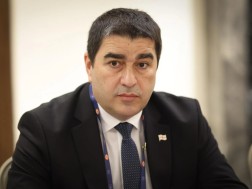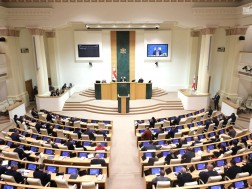


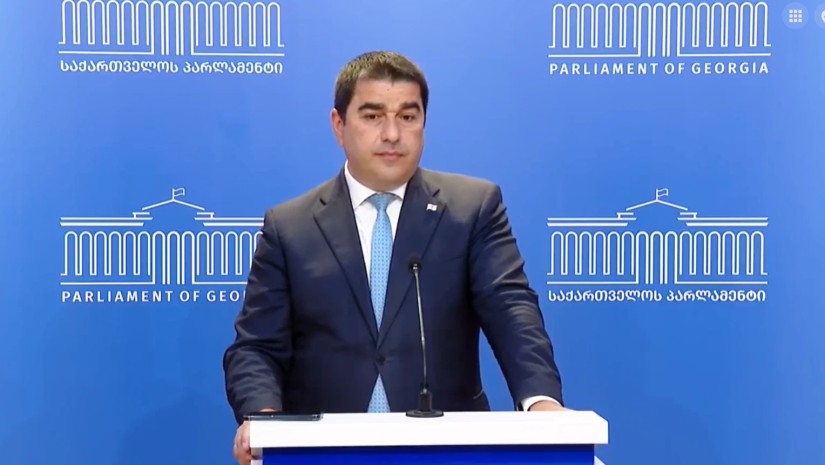

The Chairman of the Parliament of Georgia, Shalva Papuashvili, held a briefing within the legislative assembly regarding a joint constitutional lawsuit submitted by members of the Georgian Dream faction, along with the political groups People’s Power and the European Socialists. The lawsuit requests the recognition of certain political parties’ activities as unconstitutional and their subsequent banning.
According to Shalva Papuashvili, the lawsuit seeks the declaration of unconstitutionality for the activities of three political parties and their prohibition. These parties are: Unity-National Movement, Coalition for Change-Gvaramia, Melia, Girchi, Droa, and Strong Georgia–Lelo for the People, for Freedom.
Papuashvili also elaborated on the legal grounds underpinning the lawsuit.
“Before the 2024 parliamentary elections, the Georgian Dream political team assured voters that, should they support us, we would undertake a comprehensive political and legal assessment of the United National Movement regime. A total of 1,120,000 voters entrusted us with their democratic mandate to deliver on this promise.
Based on this public mandate, the Georgian Parliament established the “Temporary Investigative Commission of the Parliament of Georgia to Examine the Activities of the Regime in Power from 2003 to 2012, the Political Officials of that Regime, and Current and Former Officials United in Political Parties from 2003 to the Present” through resolutions passed on February 5 and April 1, 2025.
During its six-month assignment, the Commission conducted 64 live sessions, interviewed 139 individuals, and reviewed 778 applications from citizens. Following the discussion of the Commission’s nearly 500-page report, the Georgian Parliament adopted a resolution on September 3, 2025, publicly sharing the Commission’s findings. In doing so, the Parliament provided a political assessment of the actions of the United National Movement and other related parties from 2003 to 2025.
Today, we are beginning to deliver on the legal aspect of our promise. Based on the findings of the parliamentary temporary investigative commission, members of the Georgian Dream faction, the People’s Power political groups, and the European Socialists are jointly submitting a constitutional lawsuit to the Constitutional Court. The petition demands that certain political parties be declared unconstitutional and banned.
Article 23 of the Constitution of Georgia considers the activities of a political party “inadmissible” if its goal is to overthrow or alter the constitutional order of Georgia by force, threaten the country’s independence, violate its territorial integrity, engage in propaganda for war or violence, or incite national, ethnic, sectarian, religious, or social discord.
Furthermore, the activities of a political party are inherently and closely linked to the concept of a defensive democracy. This means that any activity by a political party that undermines the principles of a democratic state or threatens its fundamental values is prohibited. The European Court of Human Rights, grounded in the concept of a defensive democracy, has affirmed in its rulings that when a state authority has properly identified a risk posed by a political party pursuing policies that threaten democracy, it is within the state’s authority to prevent such policies from being implemented.
Our joint constitutional complaint aims to declare several political parties unconstitutional and to have them banned. Alongside other violations, the evidence demonstrates that these political parties have, on a near-continuous basis, denied the legitimacy of both the domestic and foreign policy of the current Georgian government and the ruling party, thereby challenging their constitutionality. In doing so, the parties in question implicitly acknowledge that one side, either themselves or the ruling party, must unquestionably be declared unconstitutional. Our complaint presents evidence indicating that these political parties are motivated by unconstitutional objectives.
Legal Justification
The constitutional lawsuit is founded on the following violations outlined in Article 23 of the Constitution of Georgia:
– The overthrow and violent alteration of Georgia’s constitutional order;
– The violation of human rights.
An essential component of Georgia’s constitutional order is the principle of the rule of law and the safeguarding of fundamental human rights. Systematic breaches of these principles amount to a violation of the constitutional order. The facts and evidence presented in the conclusion of the Temporary Investigation Commission confirm that during the period of the United National Movement’s tenure in power, human rights violations extended beyond isolated incidents and assumed a systemic and systematic character. Specifically:
– The introduction of torture practices against individuals held in penitentiary institutions;
– The perpetration of murders and other forms of violence;
– The illegal surveillance of individuals, including unauthorised eavesdropping;
– The clandestine creation, storage, and utilisation of video, audio, and photographic materials depicting private lives;
– Actions infringing upon ownership rights and other rights of the mass media;
– The practice of extorting property and violating property rights.
Refusal to recognise the legitimacy of bodies elected through general elections, and attempts to overthrow or violently alter Georgia’s constitutional order
Since the parliamentary elections held in Georgia on October 1, 2012, nine general elections have taken place; on several occasions, the results of these elections and the legitimacy of the bodies or officials elected through them have been refused recognition. In doing so, numerous acts of sabotage have been carried out against the Georgian state by the unconstitutional political parties named in the constitutional lawsuit, despite all these elections being conducted in accordance with the Constitution of Georgia and the Election Code.
Following the 2016 parliamentary elections, the first attempt was made to declare the democratically elected government illegitimate. The United National Movement boycotted the run-off under the false pretext that the elections were illegitimate. However, they later began to use their mandates in the Georgian Parliament, which clearly confirms that there were no valid grounds for declaring the elections illegitimate.
In 2018, the coalition led by the United National Movement refused to recognise the results of the Georgian presidential elections and attempted to disrupt the inauguration of the newly elected President of Georgia using violent methods.
In June 2019, the United National Movement and several closely allied political parties attempted to storm the Georgian Parliament building.
The unconstitutional political parties declared the 2020 parliamentary elections illegitimate, refused to participate in the work of the newly elected parliament, and attempted to storm the administrative building of the Central Election Commission of Georgia. However, they later chose to exercise their mandates in the Georgian Parliament, which unequivocally confirms that there were no grounds for declaring the elections illegitimate.
The unconstitutional political parties also declared the 2021 local government elections illegitimate, organised protests in various cities, and renewed their calls for fresh elections. Nevertheless, they subsequently took up their mandates in local government bodies, which clearly demonstrates that there was no basis for declaring the elections illegitimate.
Following the 2024 parliamentary elections, political parties that surpassed the electoral threshold rejected the election results, refused to accept their parliamentary mandates, and declared the newly elected parliament illegitimate. Furthermore, after the elections, these unconstitutional political parties organised and participated in events that involved the forcible entry into the Georgian Parliament.
In parallel with and as a continuation of these actions, the unconstitutional political parties made several attempts between 2022 and 2025 to overthrow or violently alter Georgia’s constitutional order.
The initial attempt by unconstitutional political parties to declare the democratically elected government illegitimate was recorded in 2016. Since 2018, this endeavour has become systematic, and from 2020 onwards, it has continued consistently. Moreover, between 2019 and 2025, the declaration of the democratically elected government as illegitimate was accompanied by a total of six direct attempts to overthrow and violently replace Georgia’s constitutional order. This clearly indicates that activities carried out by unconstitutional political parties and aimed at overthrowing or violently altering Georgia’s constitutional order are long-term, systematic, and ongoing. Undoubtedly, this underscores the continued relevance of this objective today.
Between 2004 and 2012, the United National Movement violated fundamental human rights as enshrined in the Constitution of Georgia and the European Convention on Human Rights. Furthermore, all the parties identified as unconstitutional in the complaint infringed upon the core principles of democracy outlined in Article 3 of the Georgian Constitution and the European Convention on Human Rights. This was evidenced by their unjustified refusal to recognise the legitimacy of bodies and officials elected through general elections conducted in accordance with Georgian constitutional and electoral legislation, demonstrating a blatant and egregious disregard for democratic principles.
Violation of Georgia’s Independence and Territorial Integrity
Events related to the August 2008 war
During its time in power, the United National Movement engaged in numerous actions that undermined Georgia’s independence and territorial integrity. In this regard, they carried out clearly unconstitutional activities that hindered the peaceful process of restoring Georgia’s territorial integrity. These actions also served to bolster political positions, supporting the occupation of Georgian territories and reinforcing the presence of occupying forces.
Specifically, between 2004 and 2008, alongside rhetoric inciting conflict and confrontational measures, several notable facts stand out:
In 2004, armed clashes occurred in the vicinity of the city of Tskhinvali.
On September 28, 2006, the Kodori Gorge was renamed “Upper Abkhazia” by decree of the President of Georgia.
In November 2006, the then Georgian authorities organised alternative elections in the Tskhinvali region, a territory under both de jure and de facto Georgian control. These elections were unconstitutional and took place without proper legal authority. During this process, a so-called President of South Ossetia was elected, and an alternative government of South Ossetia was established under his leadership, with members referred to as ministers. By taking this action, the Georgian authorities indirectly legitimised the separatist elections in the Tskhinvali region, which represented a clear and blatant betrayal of Georgia’s national interests.
In 2007, the then Georgian authorities established a temporary administrative-territorial unit within the territory of the former South Ossetian Autonomous Region and legally reinstated the borders of the South Ossetian Autonomous Region, which had been abolished in 1990.
The culmination of these actions occurred in August 2008, when the Georgian authorities created the conditions that paved the way for the invasion of the Tskhinvali region by occupying forces. Subsequently, the Georgian government supported the resolution passed by the Parliamentary Assembly of the Council of Europe on October 2, 2008, in which they acknowledged that their actions had escalated the conflict to a new “level of open and full-scale hostilities,” and described the Russian military intervention as a “retaliatory attack.”
Since 2004, the United National Movement has systematically and consistently undertaken actions and measures that have not only contributed to the occupation of Georgian territories but have also served to strengthen the political position of the occupying forces regarding the occupation.
Events Since 2012
Since 2012, the United National Movement has continued to undertake actions against Georgia’s independence and territorial integrity, building on previous efforts in collaboration with other closely affiliated unconstitutional political parties.
These actions have undermined the prospects for a peaceful restoration of Georgia’s territorial integrity and have sought to incite active hostilities between Georgia and Russia.
From the very outset of Russia’s invasion of Ukraine in 2022, the true intentions of these unconstitutional political parties to escalate the conflict between Georgia and the Russian Federation became evident. Their goal has been to heighten tensions to the maximum level. Unconstitutional political parties are still attempting to escalate the situation between Georgia and Russia in the same manner and to the same extent as the United National Movement did before the 2008 war.
Facilitating a foreign power’s encroachment on Georgia’s independence
In addition to undermining the prospects for a peaceful restoration of Georgia’s territorial integrity and attempting to provoke active hostilities between Georgia and Russia, efforts to encroach upon Georgia’s independence have also been pursued through other avenues since 2012. Specifically, these political parties have sought to “punish” the Georgian state and government from abroad on various issues, to foster dissatisfaction among Georgian citizens, turn public opinion against their democratically elected government, and utilise these processes as tools for sabotage against the Georgian state and as leverage for exerting pressure on the government.
In particular, these efforts include actions detrimental to the implementation and maintenance of a visa-free travel regime for Georgian citizens within the territories of European Union member states. They also involve activities obstructing the country’s accession to the European Union, as well as systematic information attacks from abroad targeting the Georgian state and government, alongside attempts to impose sanctions and facilitate such measures.
Thus, between 2004 and 2012, the United National Movement actively undermined Georgia’s independence and deliberately laid the groundwork for violations of Georgia’s territorial integrity. After 2012, this political party, along with other unconstitutional parties, has made numerous attempts to encroach upon Georgia’s sovereignty and breach its territorial integrity.
These circumstances, in conjunction with the principles outlined in the Georgian Constitution and the jurisprudence of the European Court of Human Rights, collectively establish a robust constitutional basis for banning several unconstitutional political parties.
Furthermore, according to international practice, the banning of a political party, alongside its unconstitutional ideas and conduct, requires that the party in question poses a genuine threat to the constitutional order. In this context, the size, organisational structure, and political influence of the party are decisive factors. Therefore, in considering the parties subject to this proposed ban through a constitutional lawsuit, we applied two primary criteria:
To what extent is there a solid legal basis for declaring a specific party unconstitutional?
How much of a genuine threat does an unconstitutional party pose, considering its size, organisational structure, or political influence, to the constitutional order?
In light of this, our joint constitutional lawsuit seeks the recognition of the following three political parties as unconstitutional and calls for their prohibition. These parties have formed a coalition, creating a unified organisation operating under common aspirations, and continue to do so today. Their official names, as registered in the party registry, are:
Citizens’ Political Union “Unity – National Movement”
Citizens’ Political Union “Coalition for Change, Gvaramia, Melia, Girchi, Droa”
Citizens’ Political Union “Strong Georgia – Lelo, for the People, for Freedom”
Additionally, it should be noted that other political parties are closely affiliated with the aforementioned groups, such as “Elene Khoshtaria – Droa” and “Girchi – More Freedom”, which are effectively part of the “Coalition for Change, Gvaramia, Melia, Girchi, Droa”, although officially registered as independent parties.
Similarly, parties like “Yes to Europe – Strategy Aghmashenebeli”, “European Georgia – Movement for Freedom”, the “Federalist Party”, the “Republican Party of Georgia”, and various small, fictitious, one-person, and minor parties also fall into this category.
However, considering their current size and organisational structure, as well as their limited influence and the absence of any genuine prospect of surpassing the electoral threshold, there is no immediate need to ban them. The question of their unconstitutionality could be considered at a later stage, should they gain substantial influence in the political landscape.
The unifying factor of the aforementioned parties’ unconstitutional goals is evidenced by the following circumstances:
The leaders of these political parties were elected to the Georgian Parliament in various convocations, having been nominated by the United National Movement or an electoral bloc formed in collaboration with it, and have held various party or political positions.
Over the years, these parties have consistently presented a similar stance, forming a coalition unity and operating as a unified entity driven by common aspirations, a pattern that continues to this day.
At the same time, our constitutional lawsuit does not seek to terminate the mandates of members of the legislative body who were elected under the nomination of an unconstitutional political party. As of today, this only applies to the 59 members who were elected to the Sakrebulo (city council) representing the Lelo party. Firstly, we aim to respect their voters. Unlike the Lelo party itself, which refused to accept the parliamentary mandates bestowed by its voters, we remain committed to upholding the Sakrebulo mandates entrusted by the electorate.
Additionally, our lawsuit does not seek to restrict the political activities of individuals affiliated with an unconstitutional political party. As you are aware, current legislation recognises the concept of a successor party, which offers greater means to prevent the future unconstitutional political activities of individuals associated with banned parties,” said Shalva Papuashvili.