


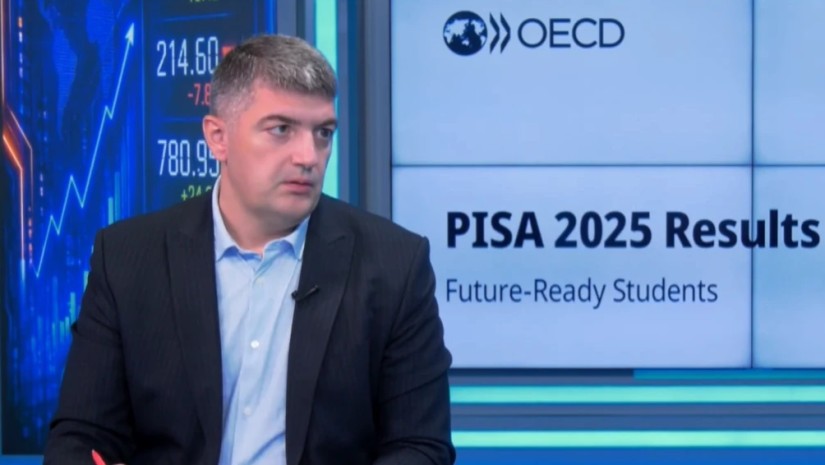

Georgia’s improvement in the PISA 2025 results was largely driven by better performance among lower-achieving students, while the share of high-performing students remained almost unchanged, according to Avto Abdushelishvili, director of Shavnabada Gymnasium.
He said the results demonstrate Georgian students’ potential when provided with the right environment. However, major challenges remain: 61% of students do not reach the basic proficiency level in reading, 53% in mathematics and 45% in science. Overall, 73% fail to meet the basic level across all three areas.
Abdushelishvili said reading comprehension remains the biggest challenge, with progress of only 10 points. He stressed that this is not solely a Georgian language and literature issue but a responsibility of the entire school system. He also cited the uncontrolled use of technology and artificial intelligence for completing assignments as a factor that may weaken students’ independent thinking and comprehension.
To address these challenges, he called for updated curricula and continuous professional support for teachers. According to Abdushelishvili, increased education spending alone will not guarantee better results; funding should prioritize long-term teacher support and practical engagement with students rather than one-off training programs.