


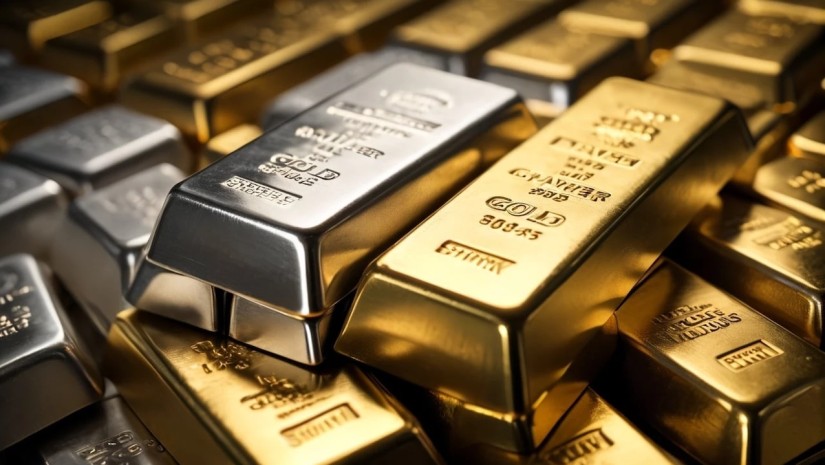

Legendary banker and Wall Street titan J.P. Morgan once remarked, "Gold is money. Everything else is credit." His words continue to resonate today, as the world grapples with economic uncertainty and shifting financial paradigms.
On the back of the still almighty U.S. dollar, the phrase "In God We Trust" is prominently displayed. However, global central banks, private capital, and policymakers in Washington increasingly seem to embrace a different maxim: "In Gold We Trust." Regardless of who is in power, gold remains a timeless asset. As United States Vice President J.D. Vance paraphrased at the Munich Security Conference, "There’s a new sheriff in town."
The global financial markets operate around the clock, constantly attempting to decipher what "America First" policies could mean for gold prices. Historically a store of value, gold is increasingly being recognized as a growth asset. Macroeconomic forces and geopolitical developments are driving a re-evaluation of gold’s price on central bank balance sheets.
The Fiscal Reality: A $2 Trillion Deficit
When President Donald Trump first vowed to "Make America Great Again," there was—and still is—an implicit need to address the ever-growing $2 trillion budget deficit in Washington, hence the white house focus on DOGE and Mr. Elon Musk. In this context, a revaluation of U.S. gold reserves could provide a strategic financial advantage for the great land of the Free.
U.S. President Abraham Lincoln famously stated: "You can fool some of the people all of the time, and all of the people some of the time, but you cannot fool all of the people all of the time." In a world increasingly focused on America First, this statement could well apply to U.S. debt and the role of the dollar as the global reserve currency.
Gold’s Lasting Value & Potential Repricing
Gold has been a highly valued commodity for over 5,000 years, with widespread industrial applications and a deep-rooted role in monetary systems. Its importance is unlikely to fade anytime soon.
A repricing of U.S. gold reserves could be a bullish signal for the market and, potentially, for the U.S. economy. Such a move would challenge the notion that gold is a "barbarous relic"—a term once used by economists who dismissed its monetary role.
The Fort Knox Factor: An Untapped Asset?
Recent discussions have turned to U.S. gold reserves, particularly the stockpile held at Fort Knox. While Treasury Secretary Scott Bessent has downplayed the possibility of revaluing the nation’s gold at market levels, speculation continues.
The U.S. owns 261.6 million troy ounces of gold, officially valued at an outdated $42.22 per ounce, equating to a book value of $11 billion. However, at today's spot price above $2,950 per ounce, that value would exceed $750 billion.
Earlier this month, U.S. Treasury Secretary Bessent fuelled speculation when he stated: "We’re going to monetize the asset side of the U.S. balance sheet for the American people." While repricing gold would primarily be an accounting exercise, it would still lead to a significant expansion of the Federal Reserve's balance sheet.
It's important to note that the Federal Reserve no longer owns gold—it was transferred to the U.S. Treasury under the Gold Reserve Act of 1934 in exchange for gold certificates. Still, a revaluation could have far-reaching implications for financial markets and monetary policy.
Gold Miners: An Undervalued Opportunity
Gold miners remain an underappreciated equity opportunity, with price returns struggling to keep pace with earnings upgrades. Supported by strong fundamentals and reasonable valuations, gold mining stocks present a compelling risk-reward profile.
As of the week ending February 20, GLD, GDX, and GDXJ closed at USD 40.80 and USD50.37 respectively, reflecting the market's ongoing interest in gold and its related assets.
GLD closed the week at USD 270.74 and XAU/USD gold spot price at USD 2940 levels.
As any good lawyer and both M. Xi Jing Ping and Vladimir Putin most probably could tell you, the United States dollar is the legal & political risk of the United States of America.
In an era where the global financial system & global trade order is being reshaped, gold’s role is once again coming into focus. Whether through repricing, central bank policies, or investor demand, the precious metal stands as a cornerstone of economic resilience.
The information provided in this article is for general informational purposes only and does not constitute investment, financial, legal, or professional advice. Any decisions made based on this information are at your own risk. Readers should conduct their own research and consult with a qualified professional before making any financial or investment decisions.
Rainer Michael Preiss, Partner & Portfolio Strategist at Das Family Office in Singapore