




Rainer Michael Preiss – Global Market Commentary
The election of the 47th President of the United States, Donald J. Trump, marked a significant political transition that financial markets moved quickly to assess.
While on the back of the US dollar it says “in God We Trust” the global financial market started to embrace the Mantra of “in Gold we Trust”
The recent nomination of Kevin Warsh to succeed Jerome Powell as Chairman of the United States Federal Reserve signaled the possibility of a shift in U.S. monetary-policy direction.
The short-term market reaction was unmistakable: a stronger U.S. dollar, rising real yields, and a sharp repricing across precious metals.
On Friday, January 29, silver prices suffered a sudden and severe sell-off, erasing a substantial portion of the metal’s recent gains in a single trading session. The move followed an extraordinary rally earlier in the month and exposed the fragile balance between speculative enthusiasm and market reality.
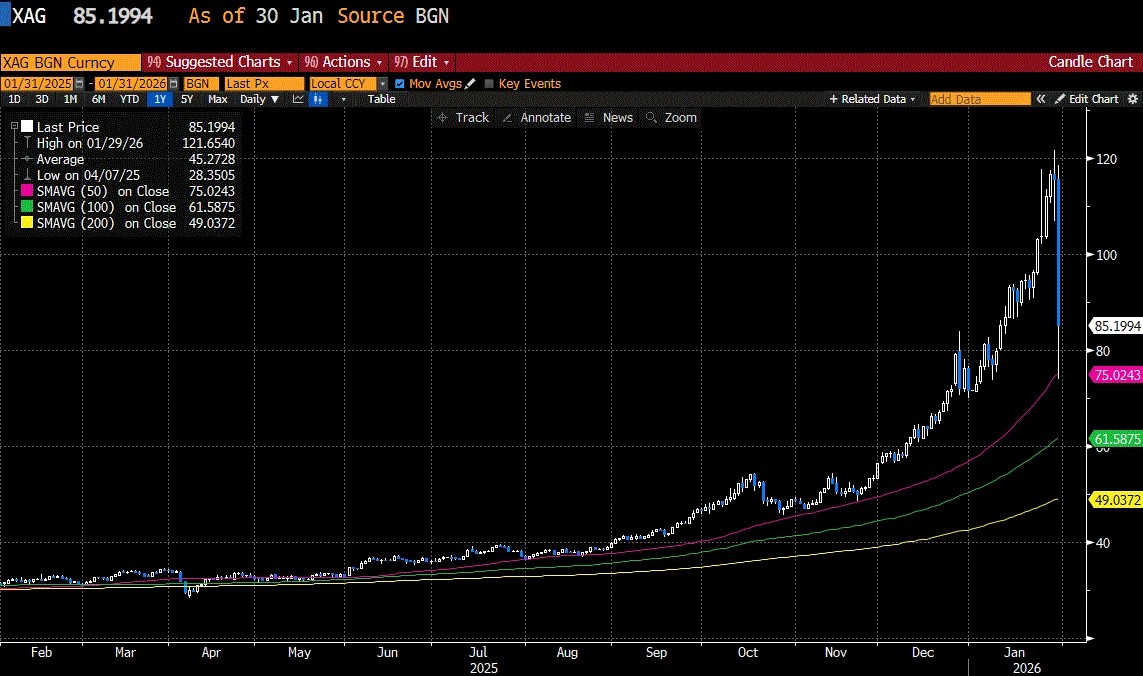
Gold suffered its biggest slide in forty years, and silver posted a record intraday decline in a stark reversal of the rally that lifted prices to all-time highs. Gold fell more than 12% to slump below $5,000 an ounce in its biggest intraday decline since the early 1980s. Silver plunged as much as 36%, a record intraday decline
In the weeks leading up to the sell-off, silver had surged aggressively, fueled by safe-haven demand, inflation-hedging narratives, strong industrial-use themes, and rapidly accelerating speculative momentum. Positioning became crowded, leverage increased, and volatility compressed—a classic late-stage warning signal in commodity markets.
Once prices began to roll over, the decline proved swift and unforgiving. What started as profit-taking quickly escalated into forced liquidation. Margin calls, algorithmic selling, and technical breakdowns fed on one another, amplifying downside momentum.
Silver’s smaller and thinner market structure, combined with its dual identity as both a precious metal and industrial input, magnifies volatility. Short-term pricing is dominated by futures markets and speculative flows, leading to sharp disconnects between physical fundamentals and paper-market pricing.
The January 29 episode should not be viewed as an anomaly. It is a feature of the silver market. For investors, the lesson is clear: position sizing, liquidity management, and time horizon matter.
For disciplined investors, such volatility can create opportunity. For leveraged or momentum-driven participants, it can be punishing. The lesson from January 29 is clear: silver rewards patience and risk control, but it offers little mercy to complacency.
Gold & silver as a strategic asset allocation decision not a” Johnny come lately” momentum trade.
Gold and silver should be treated as strategic asset allocation decisions, not short-term momentum trades. Fortune and wealth preservation favors the prepared mind.
Rainer Michael Preiss, Partner & Portfolio Strategist at Das Family Office in Singapore