


In an increasingly competitive world, more families are asking which education pathway gives their children the best chance at elite universities. The answer, backed by data, is consistent: the Cambridge International pathway.
I. What are IGCSEs and A-Levels - and why do they matter?
If you are a parent with school-age children, you have almost certainly encountered these two abbreviations. But what do they actually mean, and why have they become the preferred pathway for families who are serious about top global university admissions?
The International General Certificate of Secondary Education (IGCSE) is a two- year qualification developed by Cambridge International Education - department of the University of Cambridge, UK and one of the world’s leading and most respected international education providers. The programme is usually taken by students aged between 14 to 16. Think of it as a rigorous, internationally standardised secondary school curriculum covering mathematics, the sciences, the humanities, languages and the arts. Students choose their combination of subjects and sit formal external examinations at the end of 10th Grade. It is, in essence, the global version of the British GCSE, but specifically designed for international schools and students around the world.
A-Levels (Advanced Levels) follow immediately after, typically for students aged 16 to 18. Here, students narrow their focus to three or four subjects which they study with genuine depth and intellectual rigour over two years. That specialisation is deliberate and, as we will see, is exactly what makes the qualification so compelling to university admissions offices from Oxford to Yale.
Together, the IGCSE-to-A-Level sequence is often called the Cambridge Pathway. It is the most internationally portable secondary education standard in the world.
II. The university recognition picture - in plain numbers
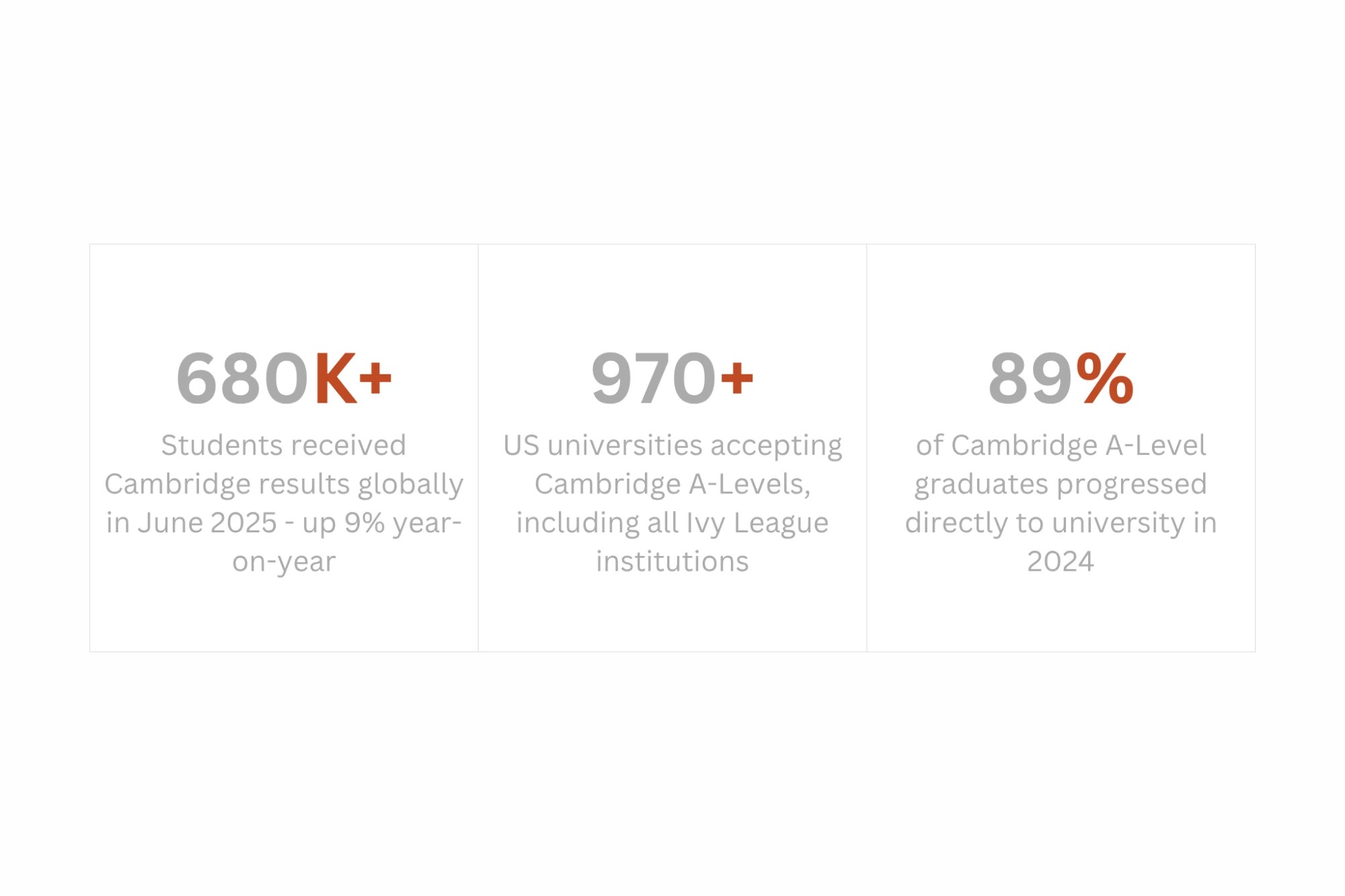
This is where the evidence becomes impossible to ignore. Cambridge International A-Levels are formally recognised for university admission in over 50 countries through the Lisbon Recognition Convention. In the United States specifically, more than 970 universities - including Stanford, Harvard, MIT, Yale and every single Ivy League institution - accept Cambridge A-Levels as valid entry qualifications. That is not a marketing claim; it is a matter of record.
university recognition at a glance
- All Ivy League institutions (Harvard, Yale, Princeton, Columbia, Penn, Brown, Dartmouth, Cornell) formally accept Cambridge International A-Levels for admission
- Oxford University requires A*A*A or A*AA at a A-level depending on course – it is the primary benchmark for entry
- Cambridge University accepted 16% of all 2024/25 applicants, with A-Levels as the standard qualification
- The Lisbon Recognition Convention extends formal recognition to universities in over 50 countries across Europe and beyond
- Many US universities award advanced college credit: the University of Washington grants 15 quarter-credits per passing A-Level exam
In practical terms, a student who completes three strong A-Levels can arrive at a US university having already earned the equivalent of one semester's worth of credits. That translates directly into time and tuition money saved. For example The University of Michigan awards 6–10 credit hours per A-Level subject; some Florida institutions award up to 45 credits for Cambridge International students in total.
In Europe, the picture is equally straightforward. A-Levels are the expected qualification at UK universities. At the most competitive institutions - Oxford and Cambridge - entry requirements are set explicitly in A-Level grades, and admissions offices have decades of experience evaluating them with precision and confidence.
"Leading universities and employers worldwide value and recognise Cambridge qualifications as evidence of academic ability - a passport to success."
- Cambridge International Education, official guidance to schools and students
III. A growing global standard - the momentum behind the numbers
One way to understand the quality of an educational standard is to watch its adoption trajectory. In June 2025, Cambridge International Education released results to over 680,000 students across 149 countries - a 9% increase over the previous year. Over the past five years, the number of schools worldwide entering Cambridge examinations has grown by 38%, with a 74% growth in total examination entries. That is not the behaviour of a niche curriculum; it is the profile of a global standard accelerating.
The June 2025 IGCSE series saw 740,000 entries from over 240,000 students at 4,231 schools across 139 countries - up 5% on June 2024. Computer science entries grew 14% at IGCSE level and 19% at A-Level. Environmental Management entries rose 36%. Business and Economics entries also increased, reflecting how Cambridge's curriculum is evolving alongside the skills students need for the world they will actually enter.
Perhaps most tellingly: Cambridge's own 2024 Student Destinations Survey found that 89% of A-Level graduates progressed directly to university after graduating - and 42% of those students chose to study abroad. The international portability is not theoretical. It is what actually happens.
IV.The academic case: why depth matters more than breadth
One of the most frequently misunderstood aspects of the Cambridge system is its deliberate focus on depth rather than breadth - particularly at A-Level. While national curricula in many countries ask students to take ten or more subjects simultaneously, an A-Level student masters three or four subjects at a genuinely advanced level. This is not a constraint. It is a strategic advantage.
US admissions officers explicitly view strong A-Level results as evidence of preparation that is comparable to - and in many cases exceeds - the most rigorous high school coursework available in the American system, including Advanced Placement courses. When a student presents an A* in Mathematics and an A in Chemistry and Physics, admissions committees understand immediately what that means. The grade requires no translation, no explanation, and carries no ambiguity. Subject mastery under external examination conditions, assessed by Cambridge's independent marking teams, is a signal that speaks for itself.
The system also develops precisely the skills that universities say they want most: independent thinking, long-form academic writing, analytical reasoning, and the ability to manage sustained effort toward a high-stakes outcome over two years.
Students who have been through the A-Level experience consistently report a smoother transition to university-level study than peers from less demanding secondary systems.
V. A direct guide for parents: five reasons to choose this pathway
If you are a parent weighing secondary school options for your child in Tbilisi, the following is practical counselling F not promotional language. Here is what the evidence actually supports:
F O R PA R E N T S A N D S T U D E N T S - W H AT T H E C A M B R I D G E PAT H WAY D E L I V E R S
- A universally recognised qualification. Whether your child ultimately applies to Oxford, Sciences Po, Columbia, or the University of Toronto, Cambridge A-Levels are understood and respected by admissions offices across all those destinations - and 970+ US institutions alone. You are not gambling on weather a qualification will be accepted. The recognition in established and documented.
- Real financial value through credit transfer. Strong A Level results translate into advanced college credit at US universities. Depending on the institution, your child could enter university with the equivalent of one semester already completed — meaning lower tuition costs, earlier access to advanced coursework, and sometimes the ability to graduate in three years instead of four.
- An admissions profile that stands out. International applicants to competitive universities face enormous competition. Cambridge qualifications provide an admissions profile that is immediately legible to every institution worldwide. An A* is an A* - no conversion tables, no explanatory footnotes required.
- Genuine academic preparation for university-level work. The depth and rigour of A-Level study means students arrive at university genuinely prepared for degree-level thinking. They have already experienced independent study, extended writing, and sustained academic discipline. The first year of university is challenging for everyone - but less so for students who have already been working at this level.
- A global peer community with long-term professional value. With over 680,000 students in 149 countries sharing the same educational framework, your child is joining one of the world's most internationally networked academic communities. The shared language of the Cambridge curriculum its standards, its expectations, its culture - creates connections that extend well beyond the classroom.
S C H O O L P R O F I L E
British International School of Tbilisi (BIST)
Georgia's most established fully British international school - located at Lisi Lake, Tbilisi
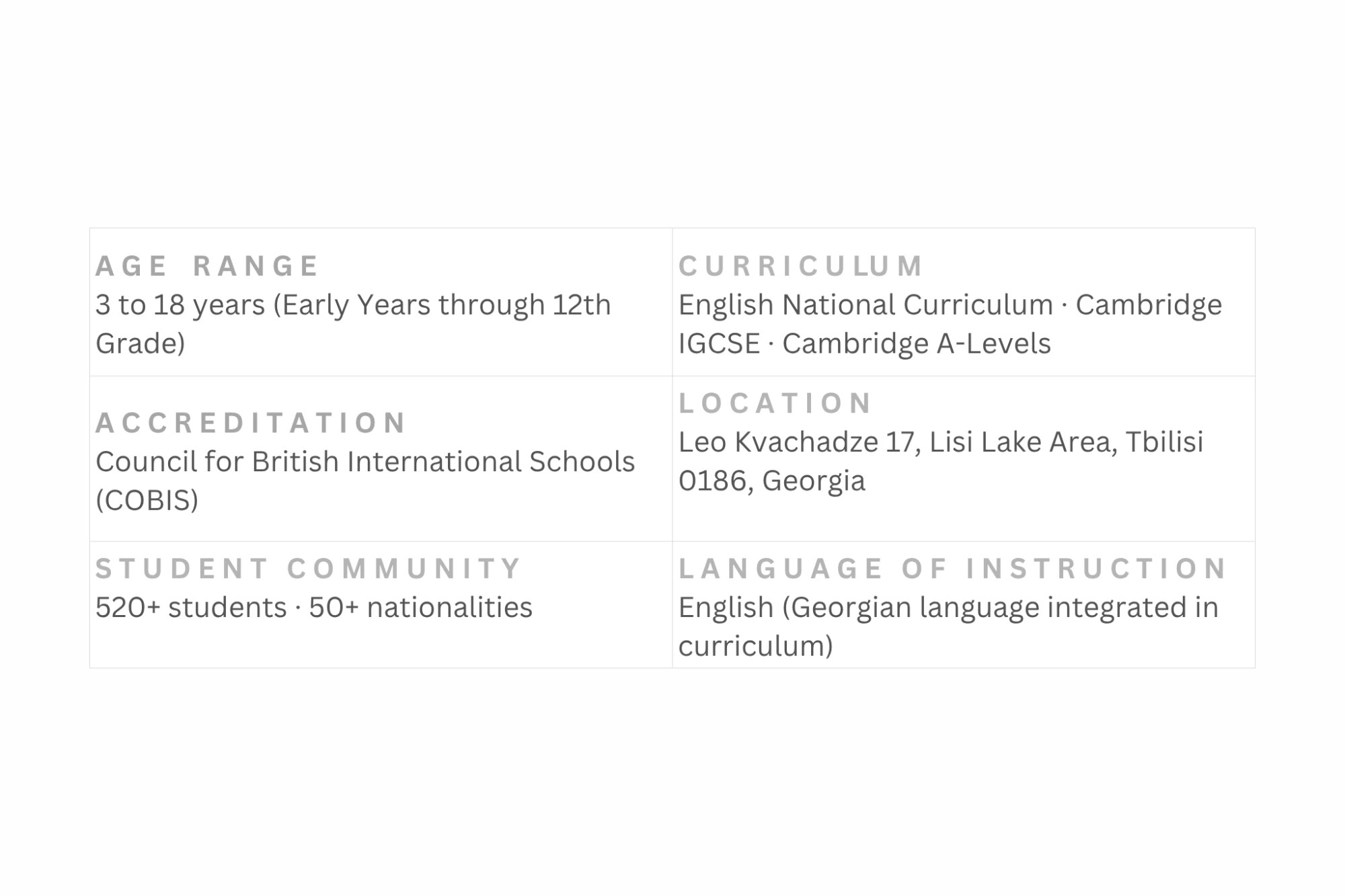
For families in Tbilisi seeking the Cambridge pathway described throughout this article, the British International School of Tbilisi (BIST) is Georgia's only fully accredited British international school delivering the complete Cambridge curriculum from Early Years through to A-Level graduation.
BIST is accredited by the Council of British International Schools (COBIS) and recognised by the National Centre for Educational Quality Enhancement in Georgia. The National Curriculum for England serves as the foundation of the Key Stage 3 programme, while students at Key Stages 4 and 5 follow the Cambridge IGCSE and A-Level pathways - the same qualifications described throughout this article. All subjects are taught by specialist teachers who are either British native English speakers or have experience teaching the UK curriculum in British schools.
With over 520 students representing more than 50 nationalities, BIST is genuinely international in its student body while remaining firmly British in its academic culture and values. Nearly 20% of students have Georgian heritage, and the school integrates Georgian language and culture into the curriculum - an important feature for local families seeking international education without losing connection to their roots.
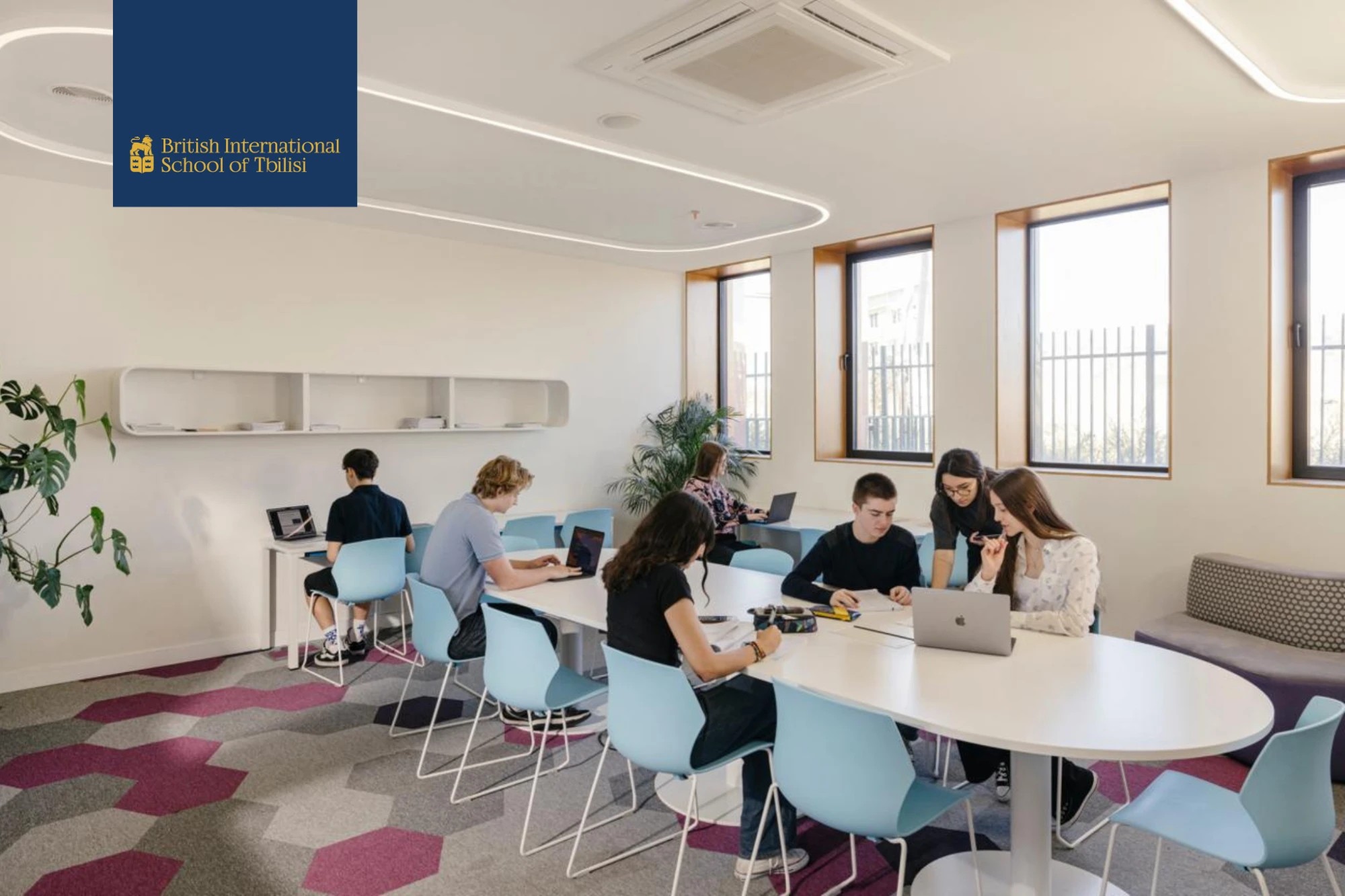
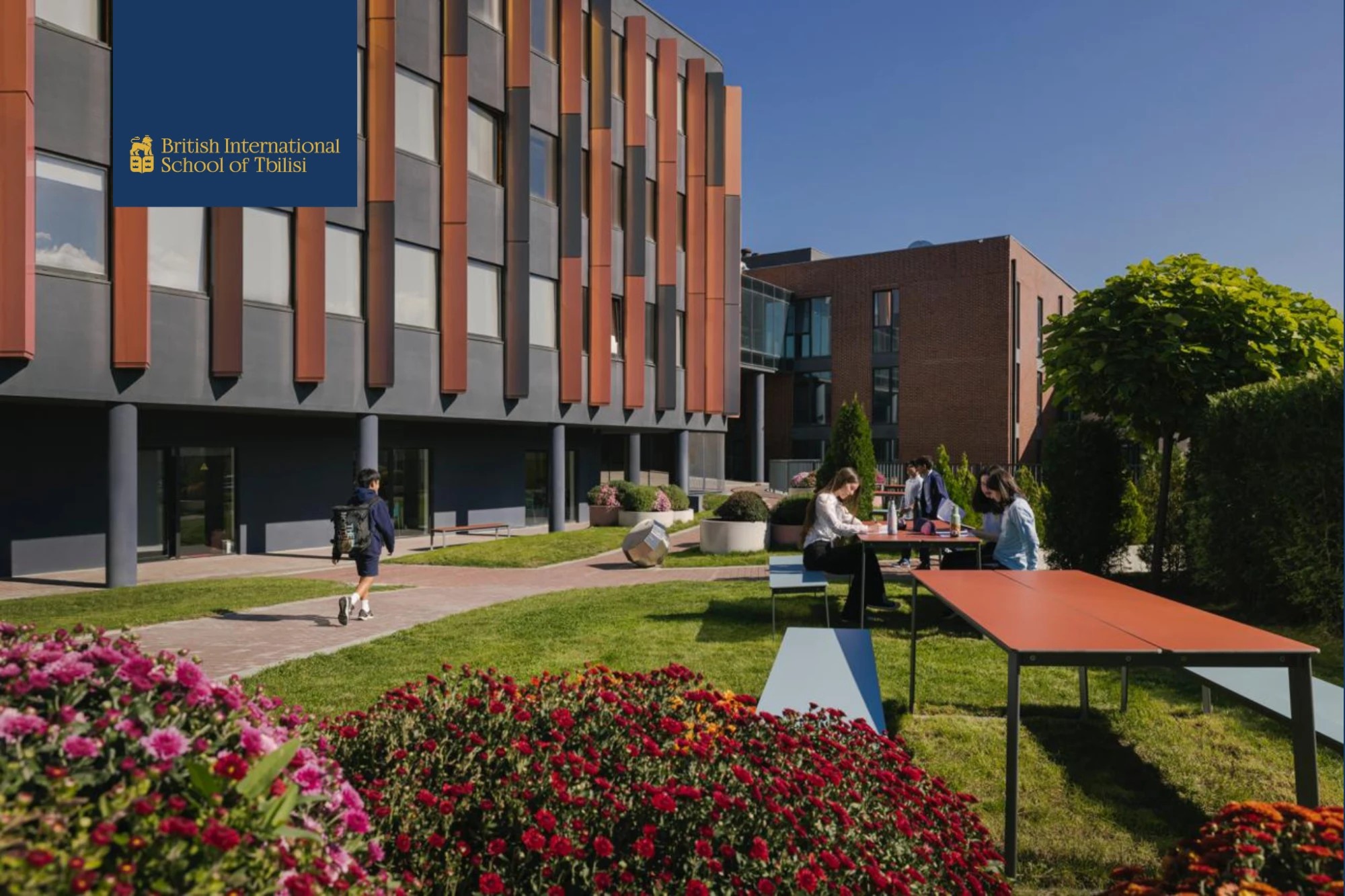
The school campus - situated next to Lisi Lake - includes state-of-the-art facilities: an Innovation Centre, performing arts spaces, science laboratories, and an extensive sports complex. BIST also operates a dedicated university guidance team that supports students through the entire application process for universities around the world.