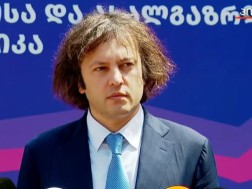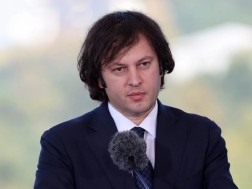


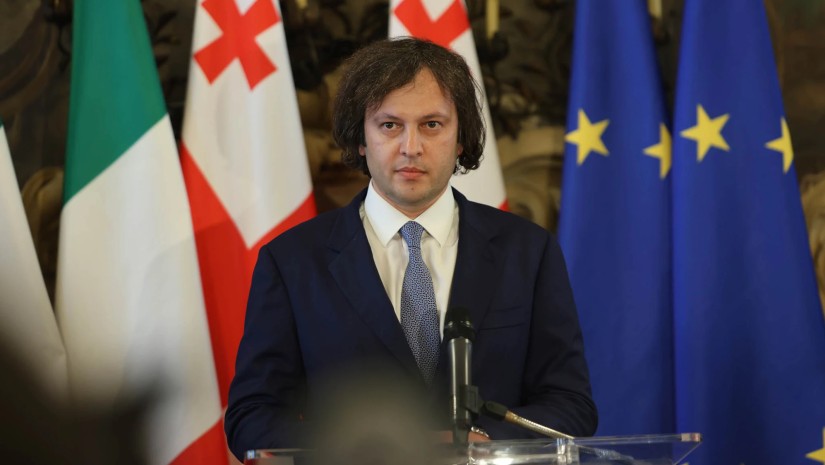

GD Prime Minister Irakli Kobakhidze has responded to growing criticism from the European Union, stating that the country’s peace and stability will always take precedence over visa liberalization with the EU. Speaking to journalists, Kobakhidze emphasized that if forced to choose, the Georgian government will prioritize domestic stability over EU travel benefits.
“If the issue is posed like this - either peace and stability or visa liberalization, of course, we will give preference to peace and stability. This is the choice of the Georgian people,” Kobakhidze said.
The Prime Minister dismissed the idea that visa-free travel constitutes a vital national interest.
“Whether you go to Europe with a citizen visa or without a visa is not an existential issue. What they are offering us, to disrupt our peace and stability, is an existential issue,” he remarked.
Kobakhidze also addressed the controversy surrounding the "Law on Transparency of Foreign Influence," which has been widely criticized by Western partners and local civil society groups. He referred to it instead as the “Law on Transparency of Revolutions,” arguing that any external funding of political movements or protests should be conducted openly.
“If someone wants to finance revolutionary processes in Georgia, this should be done transparently,” he said.
Kobakhidze further accused the EU of pressuring Georgia inappropriately and compared the tone of Brussels’ communications to that of the Soviet Union.
“It is wrong to blackmail the Georgian people because they did not return a bloody political force to power,” Kobakhidze stated.
“We are ready to hold a healthy discussion with all parties on all issues. But it is important that the Georgian public is not presented with the European Union as if it were Soviet Moscow.”
Kobakhidze’s remarks come amid rising tensions between Tbilisi and Brussels over democratic backsliding and the government's contentious legislative agenda. The European Commission has recently hinted at the possibility of suspending Georgia’s visa-free regime with the EU, a development that would significantly impact Georgian citizens’ ability to travel freely across Europe.