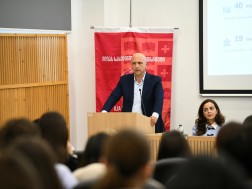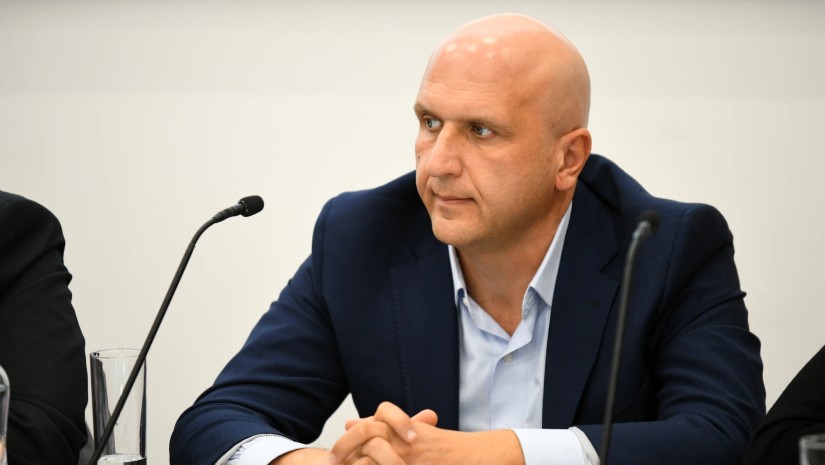

Varlam Ebanoidze, Head of Fintech and SupTech Development at the National Bank of Georgia (NBG), highlighted the growing cooperation between Georgia and South Korea in financial innovation during the 2nd Korea–Georgia Economic Cooperation Forum held ont the 21st of October 2026.
Drawing on exchanges with Korean experts and a joint research initiative comparing open banking and MyData, he discussed how the two countries can learn from each other’s experiences in developing data-sharing infrastructure and creating new opportunities for financial services.
Sharing Experience in Open Banking and MyData
A key milestone in the cooperation has been the exchange of expertise on South Korea’s MyData framework, a system that enables individuals to authorize the sharing of their personal financial data with service providers to access integrated and personalized financial services, and Georgia’s experience with open banking and open finance. Ebanoidze’s visit to South Korea in early 2025 included an in-depth exploration of MyData practices.
The exchange subsequently developed into a joint research project comparing the two countries’ approaches. Co-authored by Ebanoidze and Kwang Seok Choi (Korea Credit information Services), the 130-page study examined the similarities and differences between Georgia’s open banking framework and Korea’s MyData ecosystem.
“Less than two years ago, I’m proud that this discussion moved to the next stage, and I had the pleasure to write this research about comparing Georgian open banking and finance practice with MyData, and Mr. Choi was co-author of this paper,” Ebanoidze noted.
Although the two countries differ significantly in market size and the scale of their financial data-sharing systems, the research identified common challenges and opportunities. For Georgia, Korea’s experience provides valuable insights into how data-sharing infrastructure can support new financial products, encourage innovation and create opportunities for fintech companies.
Turning Data Sharing into Sustainable Business Opportunities
One of the central lessons Ebanoidze drew from the comparison concerns the commercial sustainability of open finance. While data-sharing frameworks can improve access to financial information and enable more personalized services, the existence of infrastructure alone does not guarantee that participating companies will develop profitable business models.
Korea’s MyData ecosystem offers a range of services, including loan brokerage and credit scoring. However, Ebanoidze pointed to the challenges faced by companies whose services focus primarily on improving consumers’ financial health.
He emphasized the importance of asking a fundamental question when designing new data-sharing initiatives: how can businesses generate sustainable revenue from the services they provide?
Referring to the well-known film Jerry Maguire, he illustrated the issue with the phrase, “Show me the money!”
For regulators in both countries, the lesson is that successful open banking and open finance frameworks must do more than facilitate data exchange. They must also create conditions in which businesses can develop commercially viable services and generate sufficient value to sustain their operations.
This insight is particularly relevant for Georgia, where open banking is intended to help fintech companies overcome barriers to entry in a banking market dominated by two major institutions (TBC and Bank of Georgia).
Learning from Korea as Georgia Moves Toward Open Finance
Georgia began developing open banking in 2019, using the European Union’s PSD2 framework as its regulatory foundation. Since then, the NBG has worked to expand the initiative beyond payment-related information sharing and payment initiation toward a broader open finance ecosystem.
Ebanoidze explained that Korea’s experience is relevant not only because of its established data-sharing practices, but also because it offers lessons on infrastructure design and the participation of different market players.
Georgia currently operates a decentralized open banking infrastructure. As the country considers extending data sharing across additional financial services and other sectors, the NBG is examining whether different infrastructure models, including more centralized approaches, could support the onboarding of new participants and improve interoperability.
The broader cooperation with South Korea therefore provides an opportunity to assess different approaches and identify solutions suited to Georgia’s market and regulatory environment.
Building a Foundation for Future Financial Innovation
The cooperation between Georgia and South Korea also forms part of a broader effort to prepare financial systems for emerging technologies, including artificial intelligence.
Ebanoidze highlighted the importance of establishing reliable data-sharing infrastructure that can interact with new AI-powered services and payment technologies. As AI agents increasingly become capable of supporting consumers with financial decisions and initiating transactions, regulators will need to consider how these systems can operate securely and communicate with existing financial infrastructure.
For Georgia, the development of open banking and open finance is therefore not only about improving current financial services. It is also about establishing the foundations for future innovation.