


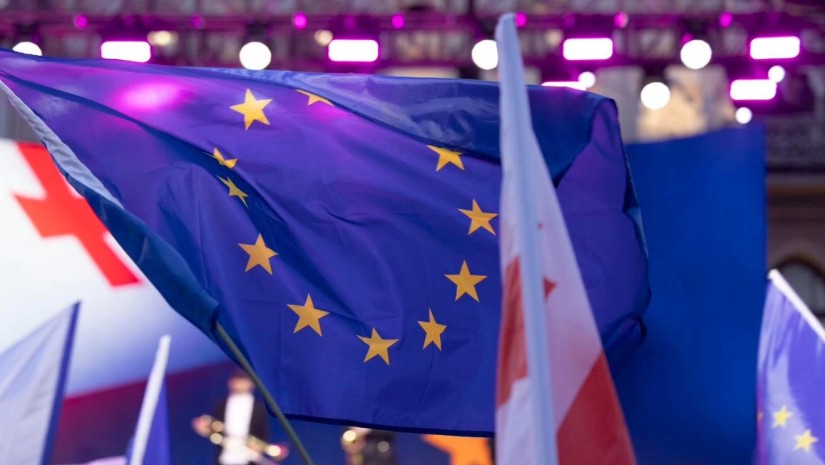

Official statistics show that trade turnover between Georgia and the European Union, as well as remittances from EU countries, reached record levels last year. This comes at a time when Georgia’s EU integration process is frozen; as noted in the European Commission’s latest enlargement report, the country currently retains only the “title” of candidate status.
Below is an overview of official data reflecting Georgia-EU economic ties.
Trade With the EU
Georgia–EU trade turnover has been growing steadily since 2021 and reached an all-time high of $5.6 billion in 2025, marking an 8.4% annual increase.
According to preliminary Geostat data, EU member states accounted for 12% of Georgia’s exports and 25.4% of its imports in 2025. More than 80% of Georgia–EU trade turnover comes from imports.
EU imports to Georgia rose by 3% last year, reaching a record $4.7 billion. The top five imported goods were:
- Passenger cars – $859.8 million
- Oil and oil products – $553.4 million
- Packaged medicines – $333 million
- Trucks – $90.2 million
- Telephone sets, including mobile and wireless devices – $87.9 million
Georgia’s exports to the EU reached $876.8 million, a 53% annual growth. The top five exported goods were:
- Ores and concentrates of precious metals – $141.9 million
- Hazelnuts and other nuts – $112 million
- Ferroalloys – $108.4 million
- Copper ores and concentrates – $66.5 million
- Mineral or chemical nitrogen fertilizers – $64.3 million
Georgia has enjoyed duty-free access to the EU market for over a decade under the Deep and Comprehensive Free Trade Area (DCFTA), which came into force on September 1, 2014. However, the country still underutilizes DCFTA opportunities. Notably, in 2025, Georgian exports to the EU reached their highest level since the agreement's launch. The EU accounted for 23% of Georgia’s total domestic exports, slightly up from 22.4% in 2014.
Remittances From the EU
Remittances from EU countries have been rising steadily since the introduction of visa-free travel in 2017. In 2025, money transfers from the EU exceeded $1.6 billion, an all-time high, representing 14% annual growth.
The EU’s share in Georgia’s total remittances increased from 30% in 2017 to 45% in 2025.
Annual remittances from the EU:
2017 – $414.1 million
2018 – $534 million
2019 – $647.1 million
2020 – $763.5 million
2021 – $955.6 million
2022 – $1.1 billion
2023 – $1.3 billion
2024 – $1.4 billion
2025 – $1.6 billion
Tourism From the EU
According to the National Tourism Administration, Georgia recorded around 500,000 visits from the EU last year - a 14% annual increase. However, no EU member state ranks in the top 10 visitor countries, whereas before the pandemic some did.
Germany leads among EU states with 84,000 visitors, placing it 13th overall. It is followed by Poland with 80,000 visitors, reflecting a 20% annual increase.
EU Foreign Direct Investment (FDI)
In the first nine months of 2025, Georgia received $499 million in FDI from the EU - a 53% annual increase. The highest EU FDI inflow was recorded in 2022, exceeding $850 million. This figure decreased to $675 million in 2023 and $442 million in 2024.