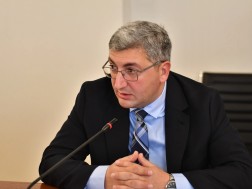
Georgia’s Deputy Finance Minister Giorgi Kakauridze has attributed delays in the implementation of major energy and infrastructure projects primarily to contractors failing to meet construction deadlines. He made the remarks during a meeting of the Defense and Security Committee, responding to a question from For Georgia MP Sophio Khorguani about reductions in funding for several strategic projects.
Khorguani questioned why funding was being reduced for several initiatives, including power transmission lines (GEL 81 million), geological studies for the Black Sea submarine electricity cable (GEL 23.9 million), the rehabilitation of the Vardnili and Enguri hydropower plants (GEL 33 million), and rural fiber-optic internet infrastructure (GEL 31.4 million). Kakauridze said that, in most cases, contractors had failed to complete the work within the scheduled timeframe. He added that the government plans to strengthen monitoring and enforce penalties to ensure deadlines are met.
Regarding high-voltage transmission lines, Kakauridze said budget execution currently stands at 76%, making full utilization by the end of the year unlikely. Delays have been caused by both contractors' slow performance and issues with local residents, although around 95% of the latter have reportedly been resolved. He acknowledged that some delays stem from objective circumstances, while others reflect companies' inability to deliver on time.
Kakauridze also explained that the Enguri HPP rehabilitation has been postponed as consultations with international financial institutions and foreign experts are still underway. The project is estimated to cost EUR 100–150 million. Meanwhile, geological studies for the Black Sea submarine cable have been delayed due to the limited availability of specialized research vessels, weather conditions and the need for permits from both Georgia and Turkey. The vessel is expected to be ready in spring next year, when weather conditions allow the studies to begin.