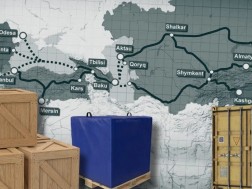



Three years after their initial interview in Tbilisi, Elene Kvanchilashvili sat down once again with World Bank official Shomik Mendiratta to discuss the evolving dynamics of the Middle Corridor. The conversation unfolded against the backdrop of the World Bank's analytical assessments of the Trans-Caspian transport route, most notably highlighted in its flagship study The Middle Trade and Transport Corridor: Policies and Investments to Triple Freight Volumes and Halve Travel Time by 2030.
Mendiratta noted that the current landscape represents a fundamental shift from three years ago, when many viewed the route as a temporary workaround to geopolitical shocks. Today, supply chain resilience has become a global standard, cementing the Middle Corridor at the center of international trade discussions. He emphasized that the World Bank's recent diagnostic differs fundamentally from earlier studies due to its broader scope, deeper analytical rigor, and focus on a "transformative scenario" aimed at aligning the corridor's performance with global best practices.
Addressing the financial scale of this transformation, Mendiratta explained that maintaining core corridor capacity requires roughly $25 billion in targeted infrastructure investments, with additional enabling investments across the wider transport network. Addressing concerns over financial feasibility, he highlighted that 85% of these core projects have already reached financial closure. While funding currently flows from international financial institutions, national budgets, and commercial entities, Mendiratta stressed that expanding private capital depends on modernizing state-owned enterprises (SOEs).
Commercial capital, driven by institutions like the IFC and MIGA, thrives in environments with transparent regulations and commercially-oriented SOEs.
In the Georgian context, Mendiratta pointed to the proposed Anaklia Deep Sea Port as a prime example of these institutional recommendations in practice. With Poti Port operating near its practical limits, he affirmed that an economic and financial case exists for additional capacity, noting that "if there's competition between ports, it heralds efficiency." The government’s adoption of the "landlord port model" provides a structured blueprint where the state funds public access infrastructure, breakwaters, and dredging, while private terminal operators are brought in through competitive concessions.
At the same time, Mendiratta dispelled the notion that Anaklia’s development diminishes the strategic value of Poti, describing Poti Port as "a jewel for Georgia." Because Anaklia will require at least three years to come online, optimizing Poti’s operations, hinterland access, and dry bulk handling remains a short-term operational priority. Once Anaklia is operational, both ports are expected to complement each other to handle growing trade volumes.
Regarding Georgia's broader positioning, Mendiratta observed that the country is exceptionally well-placed along the route. Recent capacity upgrades along the Baku-Tbilisi-Kars (BTK) line, ongoing institutional reforms at Georgian Railway, and fleet expansions through additional locomotives demonstrate tangible progress. He stressed that Georgia’s primary opportunity lies in soft connectivity—taking a leadership role in digitalization, customs synchronization, and corridor-wide coordination systems.
On the topic of regional logistics infrastructure, Mendiratta expressed optimism regarding TRIPP and TRACECA initiatives, viewing expanded land connectivity through Türkiye as a major catalyst for regional freight mobility. He reiterated that the corridor serves dual purposes: acting as a vital trade lifeline for landlocked Central Asian economies while functioning as a competitive route for intercontinental container traffic. To capture lasting value from these transit flows, Mendiratta advised Georgia to invest in warehousing, logistics hubs, and value-added processing facilities, ensuring that increased corridor performance directly yields local employment and economic growth.