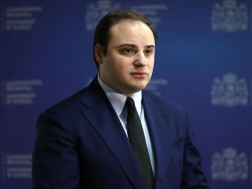




In a recent farewell interview, Peter Fischer, Germany's outgoing ambassador to Georgia, cautioned against overstating the importance of the Middle Corridor. His remarks answered a narrative the Georgian government has promoted with growing insistence: that the corridor is strategically indispensable to Europe, and that because it runs through Georgia, Brussels has little choice but to soften its stance and engage Tbilisi on more favorable terms. The two sides read the corridor's significance very differently. This article assesses it on its merits.
Background
In March 2022, weeks after Russia's full-scale invasion of Ukraine, Azerbaijan, Georgia, Kazakhstan, and Turkey signed a declaration to deepen cooperation on the route; that November, their foreign and transport ministers followed with a 2022–2027 roadmap for removing bottlenecks. Together, these marked a new phase for the Middle Corridor — an effort to strengthen Europe–Asia connectivity along a path that bypasses Russian territory.
The concept itself is not new. It dates to the early 2000s, when Turkey first promoted it as a way to connect the wider Turkic world of Central Asia while positioning itself as a transit hub between China and Europe. At the time, it drew little interest from either Beijing or Brussels and was often dismissed as an expression of Pan-Turkic ambition.
For years the corridor remained in the shadow of competing routes. Its infrastructure was inadequate, and goods had to cross multiple countries, customs regimes, and tariff zones. The Northern Corridor — mainly a railway route through Russian territory — offered greater efficiency, larger capacity, and fewer border complications, and it remained the preferred option for Europe–Asia trade, especially for China.
The war in Ukraine changed that calculus. As Russia became an unreliable transit partner, both Europe and China began looking for alternatives. Disruptions in the Red Sea and the Suez Canal sharpened that interest, and more recent tensions around the Strait of Hormuz have drawn unprecedented attention to the route and its potential to supplement — or partly replace — established East–West corridors.
A second factor has raised the corridor's strategic profile: Central Asia's emergence as a major source of critical minerals. In an era of artificial intelligence, advanced semiconductors, and digital infrastructure, access to these inputs is becoming essential not only to economic development but to technological and military competitiveness.
The Middle Corridor's importance for Europe
Despite the contrasting assessments offered by Tbilisi and Berlin, the underlying question stands: do Georgians overstate the corridor's significance, particularly for the European Union?
From a purely logistical standpoint, the corridor's potential is modest. Sustained investment since 2022 has lifted annual transit volumes from roughly half a million tons to around five million. The World Bank projects that volumes could roughly triple from their 2022 level to some eleven million tons by 2030. Even so, these figures remain small beside established routes: the Northern Corridor has an annual capacity of about 100 million tons, and the Strait of Hormuz carries some 20 million barrels of oil and petroleum products a day. The Middle Corridor is therefore unlikely to become the principal artery between Europe and China. That ceiling, however, does not determine its influence on Europe's economic and geopolitical trajectory.
Central Asia's energy wealth has long drawn European interest, but geopolitical constraints — and Russia's determination to preserve Europe's dependence on its exports — frustrated efforts to build direct links. Europe nonetheless kept investing in the region, particularly in transport and connectivity. With Russia now pinned down in Ukraine, direct energy cooperation between Central Asia and Europe has moved from aspiration toward possibility.
Beyond energy, Central Asia has recently emerged as a significant source of critical minerals. Rare earth elements and strategic metals — scandium, yttrium, neodymium, and other lanthanides — are essential inputs for electric vehicles, wind turbines, semiconductors, advanced manufacturing, and modern defense systems. Securing access to them matters increasingly to a European Union intent on strengthening its economic resilience and strategic autonomy.
To deepen connectivity with the region, the European Union has committed substantial resources. At the 2025 EU–Central Asia summit, Brussels announced a €12 billion package for transport infrastructure, digital connectivity, and other strategic projects. European institutions are also working with regional governments to align customs procedures and digital systems with EU standards, easing the movement and tracking of goods. Brussels has advanced plans for a Black Sea submarine cable to strengthen the digital links between the South Caucasus, Central Asia, and Europe. These commitments have been matched by an intensification of high-level diplomacy, visible in the rising number of senior European visits to both regions.
The Middle Corridor in the context of Georgian–European relations
Just as the Middle Corridor seemed poised to become another point of convergence between Georgia and the European Union, relations between Tbilisi and Brussels deteriorated sharply. In 2024, the Georgian government — once a frontrunner for EU membership — suspended its accession process, and criticism of the Union became a fixture of official rhetoric. The European Parliament responded with several resolutions calling for sanctions on Georgian Dream officials.
The scale of Europe's investment and the intensity of its diplomacy leave little doubt that Brussels considers the Middle Corridor strategically important. Yet that interest has not improved its relations with Georgia. Some credible experts and institutions have urged Brussels to recalibrate — to approach Tbilisi pragmatically, as it does Azerbaijan and several Central Asian states, rather than through a primarily value-based lens. The EU has held to its principled position.
Georgia presents Brussels with a particular difficulty. Few countries in the region have absorbed comparable political, economic, and institutional investment from the Union over the past two decades. Georgia's political turn has therefore produced a disappointment that European policymakers find hard to ignore.
A further complication is how Tbilisi positions itself within the corridor. The government increasingly casts Georgia as an indispensable, irreplaceable node between East and West. Asserting geographic advantage is legitimate in principle; here it reads externally as an attempt to convert geography into pressure on traditional partners.
That posture, and the broader deadlock, pushed Western policymakers to weigh alternatives that would diminish Georgia's role. As efforts to normalize Armenian–Azerbaijani relations advanced — particularly around the Zangezur Corridor — attention turned to a wider transit initiative now known as the Trump Route for International Peace and Prosperity (TRIPP). Despite holding a geographical advantage and cutting travel time by 25% compared to the Baku-Tbilisi-Kars Railway, the TRIPP route still cannot replace Georgia's strategic role in the Middle Corridor.
Georgia possesses several structural advantages that reinforce its role as a key hub connecting East and West. Most notably, alongside its overland transport infrastructure, the country benefits from access to the Black Sea, where its ports are integrated with the national railway network. This multimodal connectivity facilitates the efficient and cost-effective movement of goods between Europe and Asia. Georgia’s maritime infrastructure also carries considerable strategic importance in the energy sector, as Black Sea ports and terminals provide critical outlets for energy transportation and diversification initiatives.
Furthermore, both the current cargo-handling limitations of the Middle Corridor and the growing volume of trade between Asia and Europe, there is sufficient demand to accommodate multiple transit routes across the South Caucasus. Rather than competing directly, the existing and proposed corridors are likely to operate in a complementary manner.
Brussels has not formally opposed TRIPP, but its engagement has remained largely invisible in practice. The ownership structure helps explain why: under the framework signed in May 2026, a US entity linked to the Development Finance Corporation would hold a 74 percent stake in the joint venture overseeing the corridor, against Armenia's 26 percent. The project's most prominent advocate has accordingly been the Trump administration, which treats the route as central to connecting Central Asia — a region whose rare earth potential, underscored by Kazakhstan's 2025 Karagandy discovery, has become a declared strategic priority for Washington.
Conclusion
The asymmetry is the point. Europe values the Middle Corridor, but as one instrument among several for securing the energy and minerals its high-tech and defense industries will need, not as a dependency that Tbilisi can price. For Georgia, the stakes run deeper: handled well, the corridor could turn a peripheral state into the indispensable gateway between East and West, anchored by Black Sea ports, overland networks, and digital infrastructure. That prospect is what Tbilisi is spending. By treating geography as leverage rather than as shared interest, the government invites precisely the search for alternatives — TRIPP among them — that would erode the advantage it claims. Brussels, for its part, has left little room for dialogue by holding its principled line without qualification. The friction serves neither side and slows the corridor that both profess to want. The war in Iran has handed Georgia a reprieve by reaffirming its place on the route; the question is whether Tbilisi treats it as a window to rebuild the partnership or as fresh proof that Europe has nowhere else to go.
Bako Kheladze is a Non-Resident Fellow at the Irregular Warfare Initiative, specializing in international relations and security studies, with a particular focus on Iran, the South Caucasus, and Eurasian geopolitics. He holds an M.A. in International Security Studies from the University of Leicester. Previously, he served as a Press Officer at the Embassy of Georgia to the Islamic Republic of Iran. He is fluent in Georgian, English, Persian, and Russian.