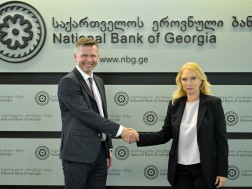




A meeting was held at the National Bank of Georgia with representatives of institutions operating in financial markets to discuss access to the China Interbank Bond Market (CIBM). Representatives of the National Bank introduced sector participants—including commercial banks, brokerage companies, asset managers, and representatives of the Ministries of Finance and Economy—to the prospects of operating on this market.
According to released information, the main topic of the meeting was the diversification of international reserves and investment in assets denominated in Chinese yuan (CNY). It was noted that the role of the Chinese yuan in the international monetary system is steadily increasing, as confirmed by its inclusion by the International Monetary Fund as the fifth currency in the SDR basket (alongside the dollar, euro, yen, and pound).
The presentation also highlighted the experience of other countries:
* Japan: investment equivalent to $10 billion in Chinese assets;
* Australia: $1.9 billion;
* Switzerland: an investment quota of 15 billion yuan (~$2.4 billion);
* The European Central Bank made its first €500 million investment back in 2017.
President of the National Bank of Georgia Natia Turnava explained that gaining access to the China Interbank Bond Market is an important stage in the development of investment policy. She also noted that investing in Chinese yuan and Chinese government securities is being carried out for diversification purposes. Overall, the share of non-core currencies is set at 10%, of which up to about 5% will be placed in yuan-denominated instruments, meaning the National Bank will invest up to about $315 million in yuan.
“Access to the CIBM allows us to manage international reserves more flexibly and efficiently, expand the range of investment instruments, and strengthen the risk-management framework. International reserves should be diversified across currencies, asset types, and geographic areas, which reduces concentration risks,” Turnava said.
The National Bank stated that it will continue to pursue a conservative and low-risk investment policy in line with international best practices.