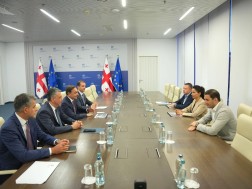




“A package of important agreements was signed during the visit to Azerbaijan, which will deepen trade and economic relations between the two countries and take the strategic cooperation between the two countries to a new level,” the Georgian Economy Minister, Mariam Kvrivishvili, stated.
According to Kvrivishvili, the agreement package covers approximately six key areas, with a particular focus on energy and transport.
“The first is the energy sector and the second is the transport direction. Azerbaijan has been our strategic partner in the energy sector for years; however, it is especially gratifying that negotiations conducted over recent months have been successfully concluded, and today we have signed a historic agreement on energy cooperation,” she said.
She noted that the agreement establishes a 20-year framework for cooperation in the gas sector, extending and updating existing arrangements that were due to expire at the end of the year.
“This is a new agreement that will make a significant contribution to ensuring the energy security of our country,” she added.
Kvrivishvili also highlighted that electricity cooperation is included in the agreement, covering import, transit, and other related areas. She said the package will further strengthen Georgia’s role as a regional transit hub and enhance its position in energy connectivity.
In addition, she said the agreement includes progress on two major infrastructure projects, including the Baku–Tbilisi–Kars railway.
“The first is the Baku–Tbilisi–Kars project itself, which has been underway for many years and whose full commissioning was delayed. I would like to thank our colleagues from Azerbaijan. Through close cooperation, we have ensured that the remaining works have been completed in the shortest possible time,” she said.
She added that the project will now be fully implemented and is expected to significantly strengthen logistics and trade links between Azerbaijan, Georgia, and Turkey, while also contributing to broader connectivity along the Middle Corridor, including China.
“This will take our logistical and trade-economic relations to a completely new stage,” Kvrivishvili said.