

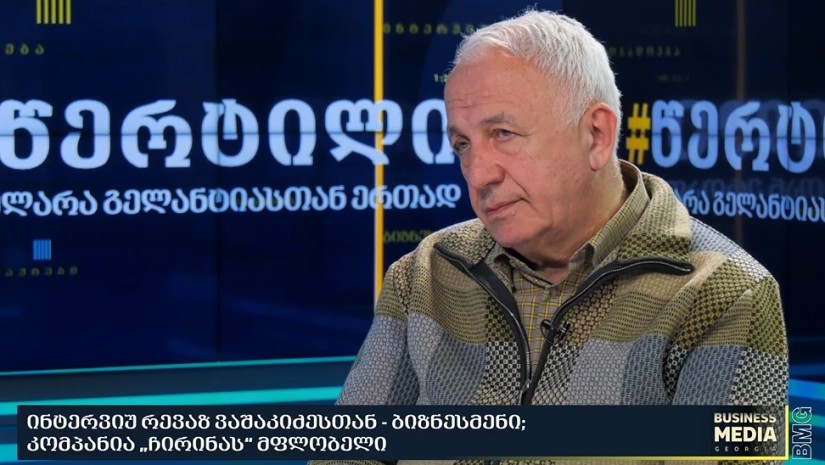

Revaz Vashakidze, founder of Chirina, expressed serious concerns about the state of Georgia’s poultry industry during an interview on Business Morning. According to him, although the company has the capacity to triple its chicken meat production, they are choosing not to scale up due to the uncontrolled and unregulated nature of the local market.
“We can produce three times more than we currently do, but we’re holding back because the market is wide open to everything,” Vashakidze said, citing unregulated imports and dumping practices as major obstacles. “The sector is facing unhealthy monopolization, making it increasingly difficult for local producers to remain competitive.”
Vashakidze challenged the official statistic that local production accounts for just 30% of poultry consumption in Georgia, calling the figure inaccurate due to the volume of unregistered and untaxed products circulating in the market. “There’s a lot of unaccounted meat out there. You see ‘yellow chicken’ being sold, none of that is reflected in the official data.”
He pointed out that the market currently allows for substandard imports, including low-quality or even spoiled meat. “For example, chicken breast isn’t popular in China, so it gets dumped here at prices below production cost. It sells for around 4 GEL, how can we compete with that? Should we raise chickens and then throw away the breast meat?”
According to him, the only viable option for Chirina has been to export to neighboring countries like Azerbaijan and Armenia. “Local production is starting to feel meaningless. And this isn’t just Chirina’s problem, it affects the entire poultry industry.”
He also raised broader concerns about the lack of policy from state institutions:
“The government needs to establish clear policies, concepts, and import quotas. If things continue this way, I may stop selling meat in Georgia altogether next year and focus entirely on exports to Arab countries. Neither the Ministry of Agriculture nor other authorities seem to be acknowledging these issues and that’s very troubling.”
Drawing parallels to other agricultural sectors, Vashakidze warned that similar risks exist in wheat and dairy production. “Russia can flood our market with cheap wheat at any time, completely sidelining local producers. The same goes for milk. If we don’t protect our market, we simply won’t be able to produce anything domestically.”