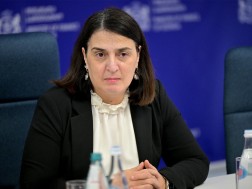

Economist Zaza Broladze says the National Bank of Georgia’s (NBG) decision to increase the Chinese yuan’s share of the country’s foreign exchange reserves to 15% lacks economic justification, arguing that yuan-denominated assets offer lower returns and limited liquidity. Speaking on BMGTV, he questioned why the NBG had decided to triple the yuan allocation in just six months.
Broladze pointed to two statements by NBG President Natia Turnava. In April, she explained the 5% cap on yuan-denominated reserves by saying that the composition of reserves should reflect Georgia’s external debt structure. Since China is not a public creditor of Georgia, Broladze said, it is unclear what has changed to justify raising the limit to 15%. He suspects the move may be driven by political considerations and preparations for potential sanctions rather than economic needs.
He also challenged the NBG’s argument that investing in Chinese securities would diversify international reserves. According to Broladze, Chinese government bonds are significantly less liquid than Western assets, while their yields are three to four times lower than those of US Treasury securities. Drawing a parallel with Russia, he said Moscow shifted part of its reserves from USD and EUR into yuan and gold after 2014, a strategy that reduced investment returns. Broladze cited estimates suggesting that investing $300 million in Chinese rather than US bonds could result in approximately $35 million less income over five years, rising to $65 million if the yuan depreciates by 2% annually. With the planned allocation now four times larger, he said, potential losses could reach $140–260 million.
Broladze also questioned why Georgia has moved more quickly to connect with China’s CIPS payment system than to join the European SEPA area, despite applying for SEPA membership in 2022. He asked the NBG to explain the basis for the 15% allocation, how it would ensure access to $1.2 billion in Chinese assets during a crisis, and who would be accountable for any resulting losses. He further called for clarification on whether the reserve shift, the easing of rules for Chinese banks and Georgian banks’ connection to Chinese payment systems form part of a coordinated policy. BMG said it would submit the questions to the National Bank.