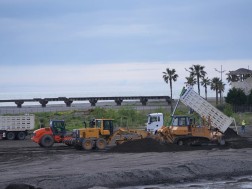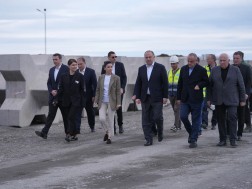




Economy Minister Mariam Kvrivishvili says the Anaklia Deep-Sea Port will handle at least 1 million TEUs by 2035, positioning Georgia as a key Black Sea hub for Central Asian cargo. She made the announcement at the Second Investors’ Forum for the Trans-Caspian Corridor in Tashkent, held under the EU’s Global Gateway initiative. The project’s first phase is expected to reach 600,000 TEUs by 2029.
The minister noted that rising transit demand, stronger private-sector interest, and deeper EU-Georgia connectivity are creating favourable conditions for expanding strategic maritime infrastructure. However, she emphasized that Georgia’s lack of a deep-water port remains a major obstacle, despite record container volumes in recent years. Progress is also slowed by unresolved negotiations with Chinese state corporation CCCC, announced as the preferred investor in May 2024 but still not finalized more than a year later.
Kvrivishvili highlighted additional challenges, including limited ferry connections with EU ports and non-harmonized customs procedures along the corridor, which increase transit costs. She proposed full digitization and data sharing across the route to streamline cargo movement. She also pointed to the upcoming Caspian Sea–Black Sea transport agreement, set to be signed in December by Turkmenistan, Azerbaijan, Georgia, and Romania, as a step toward creating a new multimodal link between the Caspian region and the EU.
Looking ahead, Georgia plans major transport upgrades by 2026, including renewing railway rolling stock, completing the Baku-Tbilisi-Kars railway, and introducing unified digital services. By 2032, the country intends to invest USD 7 billion in transport and logistics infrastructure, with the minister stressing that coordinated public and private financing will be essential to build modern, efficient regional networks.