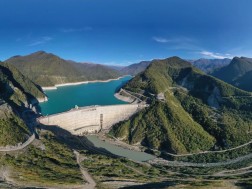


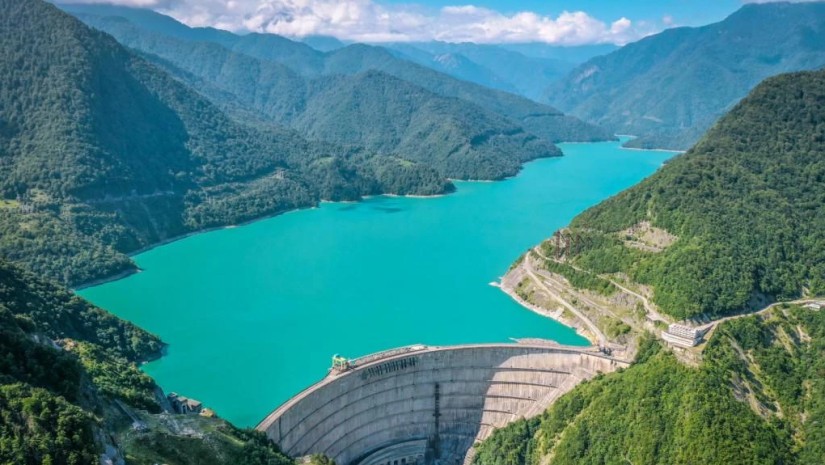

Despite recent rehabilitation efforts, the Enguri Hydroelectric Plant (HPP) is unable to perform its primary function, according to energy expert Gia Arabidze. The main issue, he says, is not just the plant's technical condition, but the misalignment of its role and the lack of alternative energy generation sources in the country.
Arabidze explains that Enguri is currently forced to function as a "base-load power station," which is not its intended role. "If we had additional plants like Khudoni, Nenskra, and Namakhvani — all of which are reservoir-based HPPs — Enguri could gradually return to its original function as a peak-load power plant, which is much more efficient," he notes. According to him, once these plants are built and total generation capacity reaches 10,000 MW, Enguri would regain its peak-load function, enabling it to effectively generate revenue and ensure the country’s peak energy supply.
Another challenge, Arabidze points out, is that during the winter months, most of Enguri's resources are directed towards supplying the occupied region of Abkhazia. "From a technical standpoint, the dam and the machinery hall are in decent condition. However, such a large facility requires much more extensive rehabilitation and operational costs," he adds.
Arabidze also highlights a major problem: during the winter months, Enguri’s electricity output is minimal for Georgia’s needs, as most of the energy is consumed by Abkhazia. "Between November and February, Enguri contributes very little to the overall energy generation in Georgia, with only about 200 million kWh of energy produced. This is not a significant amount for Georgia's power system, but it is sufficient for Abkhazia’s needs," he says.
Regarding the 40/60 agreement, Arabidze explains that the established proportion is applied on an annual basis, not monthly. "If it worked on a monthly basis, it would be a more realistic solution, but that’s not the case. However, if we look at the period from March to July, when Enguri’s output is 800-1000 MW, this energy is used for Georgia or exported. When we total this up annually, it averages out to 50/50 or 40/60. However, during peak winter periods, the situation is reversed, with 70-80% of the generated energy going to Abkhazia," he concludes.