

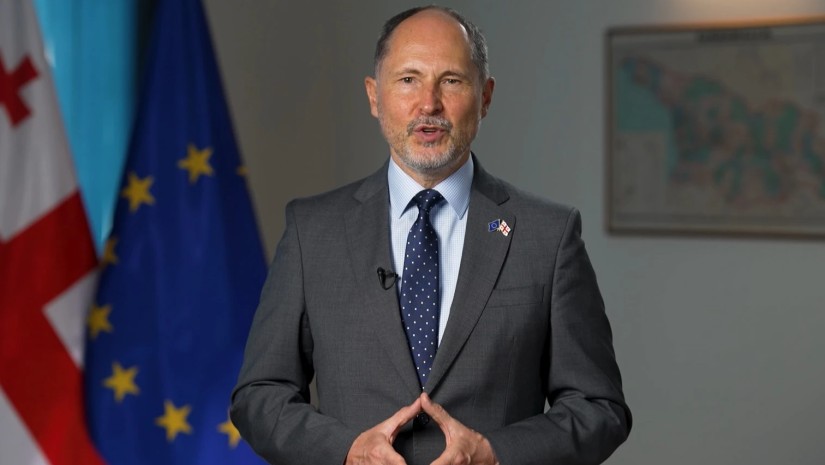

EU Ambassador Pawel Herczyński delivered a stark message in Tbilisi as he presented the European Commission’s 2025 Enlargement Report on Georgia. He warned that Georgia is now “further away from EU membership than it was in 2023”, citing unprecedented democratic backsliding, erosion of the rule of law, and a rise in anti-EU rhetoric. Despite this, Herczyński reaffirmed that the EU’s “door remains open” should the Georgian authorities choose to reverse course and realign with European values.
"Dear colleagues,
I have gathered you today to present, here in Tbilisi, the European Commission’s annual Enlargement Report on Georgia.
Accession to the European Union is a strategic and sovereign choice of each country. By applying for membership, every state commits to reforming its institutions and legal systems, progressively aligning with EU norms and standards. Equally, each country accepts the European Commission’s annual scrutiny of its preparedness for accession.
The progress of all candidate countries – including Georgia since 2023 – is assessed in the European Commission’s annual Enlargement Package, which includes ten candidate countries this year. This comprehensive and fact-based report evaluates how far Georgia has advanced on the commitments it undertook when applying for EU membership.
Some may wonder why we continue to produce a report on Georgia when the enlargement process is, in practice, de facto on hold, and when Georgian authorities themselves have announced no intention to open accession negotiations for the next four years. The reason is clear: enlargement is a merit-based and transformative process. This report provides an opportunity to take stock of where Georgia stands on its European path, and it reaffirms that the EU’s door remains open, provided the necessary steps are taken.
For me, as the EU Ambassador to Georgia, presenting this year’s report is not easy. Its findings are, unfortunately, deeply troubling for Georgia’s European aspirations.
The truth is that Georgia is further away from EU membership today than it was in 2023, when it was granted candidate status.
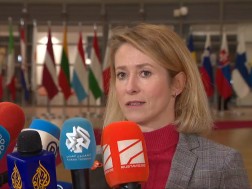
As High Representative Kaja Kallas and Commissioner Marta Kos noted, the overall level of democratic backsliding observed in Georgia over the past year is unprecedented.
Over the last 12 months, Georgia has experienced serious regression on the fundamental principles of enlargement, as well as on the nine key steps identified by the European Commission when candidate status was granted.
We have witnessed a rapid erosion of the rule of law and severe restrictions on fundamental rights.
State institutions have been instrumentalized for partisan purposes, while judicial independence has been weakened by legislative changes that risk political capture of the judiciary.
The report highlights systematic repressive actions that have damaged civic space and media independence. Cases of excessive use of force by law enforcement remain unpunished.
Equally worrying is the hostile anti-EU rhetoric, disinformation, and conspiracy theories propagated by some Georgian officials — rhetoric that directly undermines EU-Georgia relations.
The imprisonment of opposition leaders and the ruling party’s announcements about potentially banning opposition parties represent a direct attack on democratic pluralism, one of the European Union’s core values.
Technically, Georgia’s progress on aligning with EU standards has also slowed down significantly. Once recognized as a frontrunner in implementing the EU-Georgia Association Agreement, Georgia has lost that status.
EU accession remains a transformative process, but it depends entirely on the political will of the country’s leadership.
I encourage everyone to read the full 80-page report carefully. It offers an honest, comprehensive assessment of Georgia’s progress — or lack thereof — toward EU membership.
While Georgian authorities have chosen to step back, other candidate countries have pressed forward, accelerating reforms and benefiting from gradual integration with the EU. Unlike Georgia, they now enjoy tangible benefits — from modernization funds and reduced customs checks to lower banking costs and zero roaming charges.
As you heard earlier from High Representative Kaja Kallas and Commissioner Marta Kos, the European Commission now considers Georgia a “candidate country in name only.”
It is truly heartbreaking to see a country with such deep-rooted European aspirations lose ground due to political decisions that go against the will of its own people.
However, the EU’s door remains open to Georgia — if its leaders choose to reverse course and recommit to the values and principles on which the European Union is founded.
The Enlargement Report clearly outlines what Georgia must do to return to the EU path:
- Reverse the democratic backsliding;
- Uphold human rights and the rule of law;
- Advance the nine key reform priorities agreed upon in 2023.
For more than three decades, the European Union has stood side by side with Georgia — through progress and challenges alike. We have shared our prosperity, markets, education, culture, and technology, because we believe in Georgia, just as the people of Georgia believe in Europe.
I sincerely hope that the Georgian authorities will honor the will of the Georgian people, who overwhelmingly support a European future.
From our side, the EU reaffirms its readiness to continue supporting Georgians on their path toward a democratic and European future.
While the EU will never compromise on its fundamental values and principles, we are also not losing hope in Georgia.
The findings of this report should not be viewed as an end point, but rather as a wake-up call — an invitation to renew commitment and return to the European path.
The EU accession process remains merit-based and is, ultimately, entirely in Georgia’s hands.
Thank you for your attention. I am now happy to take your questions", - EU Ambassador concluded.