
In 2024, Georgia’s transportation and storage sector has maintained steady growth: sector output reached 9.7 billion GEL, 14% higher than in 2023, contributing approximately 6.6% to Georgia’s total economic output, - according to the report published by TBC Capital.
Around 31 million tons of cargo were transported to, from, and through Georgia (excluding local transportation), representing a 5% year-on-year increase. Imported cargo volumes rose by 8%, exports by 10%, while transit cargo recorded a more modest 3% growth. Transit continued to dominate, accounting for 55% of total cargo traffic, followed by imports at 37% and exports at 8%.
In 2024, the total volume of freight handled by Georgia’s ports and terminals reached 15.6 million tons, representing a 6% increase compared to 2023. General cargo accounted for the largest share at 46%, followed by liquid bulk at 34% and dry bulk at 21%.
Railway cargo volumes reached 13.7 million tons in 2024, reflecting a slight 1% annual increase. Dry cargo, comprising 61% of total rail volumes, declined by 4% year-on-year, while liquid cargo grew by 10% to 5.3 million tons. The railway utilization factor rose by 1 pp to 51%. Continuing the historic tendency, road cargo remained a major part of the total cargo transportation in Georgia.
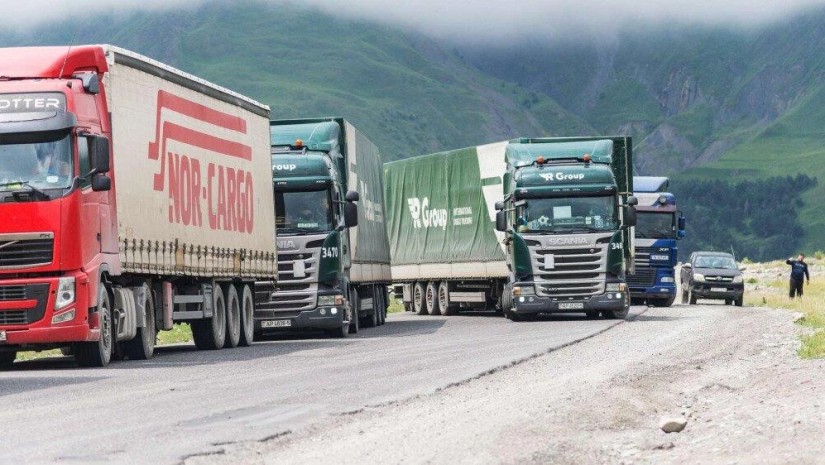
Road cargo growth maintained momentum in 2024: despite the high base set in 2023, volumes excluding local transportation increased by 4% year-on-year, reaching a new record of 14.8 million tons.
The air cargo sector, following years of contraction due to livestock export restrictions and the pandemic, continued its recovery. In 2024, air cargo volumes surged by 34% year-on-year, reaching 26.2 thousand tons, supported by shifts in global logistics patterns and growing demand for fast delivery services.
Georgia’s strategic pipeline network includes four major routes: the Western Route Export Pipeline (WREP), the Baku-Tbilisi-Ceyhan (BTC) pipeline, the South Caucasus Pipeline (SCP), and the North–South Main Gas Pipeline (NSMP). WREP operations, suspended in 2022 due to Black Sea tanker shortages and briefly resumed in early 2023, remained halted through 2024. In 2024, the BTC pipeline transported a total of 29.5 million tons of crude oil, reflecting a slight 2% decline compared to 2023. In 2024, SCP transmitted 22.8 bcm of natural gas—up 7% from 2023—reaching 95% of its utilization capacity. Meanwhile, 2.3 bcm was transmitted through the North–South Main Gas Pipeline (NSMP), reflecting a 3% year-on-year decrease.