

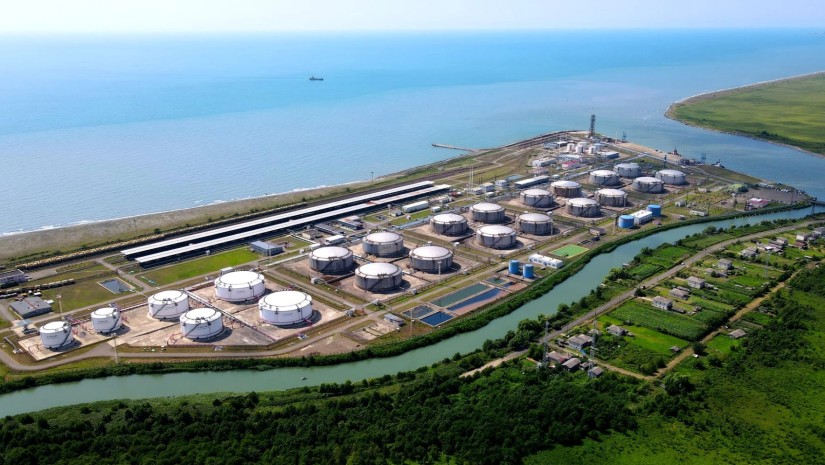

The European Union did not include the Kulevi Oil Terminal in Georgia in the 20th package of sanctions against Russia, David O’Sullivan, EU Sanctions Envoy, informed Georgian Minister of Foreign Affairs Maka Botchorishvili in a letter.
David O’Sullivan thanked the Minister for the letter dated February 18, 2026, and the document submitted to the EU member states in connection with the EU’s 20th package of sanctions scheduled to be approved shortly.
"In the letter, David O’Sullivan states that the EU has 605 ships on its sanctions list. I thank you for the letter of 18 February 2026 and the non-paper sent to EU Member States concerning the EU’s 20th package of sanctions that will be adopted shortly.
To date, the EU has listed 605 vessels, in particular tankers engaging in high risk and deceptive shipping practices. We will continue to target vessels undermining the impact of our sanctions, including by adding around 40 additional vessels in the 20th sanctions package.
Vessels are sanctioned per Council Regulation (EU) 833/2014 based on evidence that these tankers had engaged in high-risk shipping practices. This is one of the legal bases for which the EU can target vessels. Other grounds include vessels which support Russia’s energy sector, transport sanctioned goods or engage in the circumvention of EU sanctions.
The fight against the Shadow Fleet is not limited to sanctioning vessels; it requires a comprehensive approach targeting the entire logistics chain and broader ecosystem.
The EU is working to minimise its exposure to Russian energy and increase efforts to curtail Russia’s exports of petroleum products. For this reason, we impose transactions ban on enablers, such as infrastructure located in Russia and third countries, which support these activities and risk jeopardising the effectiveness of our sanctions through circumvention.
In this regard, the Kulevi Port located in Georgia was initially proposed for possible inclusion in the 20th sanctions package due to its role in the maritime transport of Russian oil and port calls by Shadow Fleet tankers.
This initial position has been reassessed following the positive commitments that your authorities and the port operator have taken. I welcome your commitment that Georgia will not allow EU-sanctioned vessels to enter its ports or receive services and SOCAR’s commitments that it will conduct its activities in strict compliance with relevant EU sanctions,
including by respecting the price cap and EU’s imports bans on Russian crude oil and of refined products made from such oil. These commitments have been critical for our review of the situation and ultimately led to the non-inclusion of the Kulevi port in our 20th sanctions package.
I noted that your authorities have already contacted the Commission requesting advice on the case of the tanker M/T TRUVOR (IMO 9676230), and I appreciate that you denied this vessel the right to call at a Georgian port. I hope that exchanges at operational level will continue and lead to a fruitful cooperation. The EU is monitoring closely the movements of the Shadow
Fleet and will continue to do so.
On trade restrictions, monitoring and curbing the re-export of EU-origin Common High Priority (CHP) items and Economically Critical Goods (ECG) remains a top priority for the Union. These items are critical to Russia's military or industrial complex, and preventing their diversion is essential to the effectiveness of our measures. We appreciate your continued
efforts in this regard and request that you continue to ensure Georgia’s territory is not used for the transit or re-export of such sensitive goods to Russia.
The EU has tools to list financial and credit institutions in third countries that have been using specialised financial systems developed by Russia to circumvention sanctions, such as the System for Transfer of Financial Messages (SPFS), the Fast Payment System (SBP) and the Russian National Payment Card System (MiR), or, more generally, that have being carrying out transactions frustrating our sanctions or supporting Russia’s war efforts.
I take the occasion of this letter to warn you that once financial institutions have been identified, they can be subject to a transaction ban in the EU. Your commitment to prevent circumvention of EU sanctions through the territory of Georgia will be monitored closely going forward, and we stand ready to act if necessary to ensure that our sanctions are not undermined. I suggest that our technical experts dealing with Russia sanctions, organise a videoconference to exchange on all the points mentioned above.
I thank you for your efforts and look forward to our continued engagement", - the letter reads.