

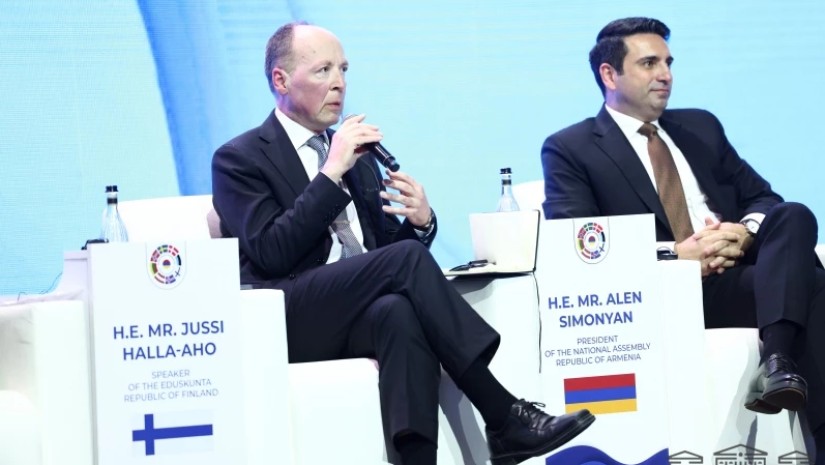

Armenia’s leadership is demonstrating a clear intent to reduce its dependence on Russia in economic and military spheres, stated Speaker of Finland’s Parliament, Jussi Halla-Aho, during an international conference in Yerevan.
At the panel discussion titled “Together for Peace and Democracy,” attended by the speakers of parliaments from the Baltic and Nordic countries on January 23, the prospects of Armenia’s European integration were discussed.
According to the Finnish politician, for Armenia to successfully progress toward the EU, it must significantly reduce its reliance on Russia, particularly in the energy sector. Halla-Aho emphasized the importance of moving simultaneously in two directions: integrating into European structures and markets while reducing Russian influence.
He assured that European partners are ready to provide Armenia with the necessary support to implement reforms.
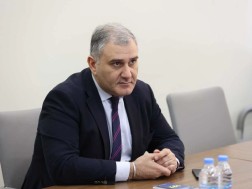
In response, Armenian Parliament Speaker Alen Simonyan noted that despite lacking a direct border with both the EU and Russia, Moscow had previously pressured Armenian leadership to join the Eurasian Economic Union (EAEU). He emphasized that while economic interdependence with Russia remains significant, the key factor is the system of values.
According to Simonyan, Armenia has already chosen the path of democratic development and is prepared to reaffirm this choice through elections or a referendum if necessary.
Earlier, BMG reported that Russia remains Armenia’s largest trading partner, with trade turnover reaching $11.6 billion in the first 11 months of 2024, marking a 71.6% increase. However, Armenian exports to Russia declined by 10.1%, from $3.3 billion in the previous year to $2.95 billion during the same period, while imports from Russia surged 2.5 times, reaching approximately $8.6 billion.
During the reporting period, Russia’s share in Armenia’s foreign trade increased from 38.6% to 42.2%.
Meanwhile, Armenia’s Parliament has begun reviewing a bill on joining the European Union, which was recently approved by the government. Prime Minister Nikol Pashinyan emphasized that this does not imply automatic membership in the EU, as the matter would require a referendum.