

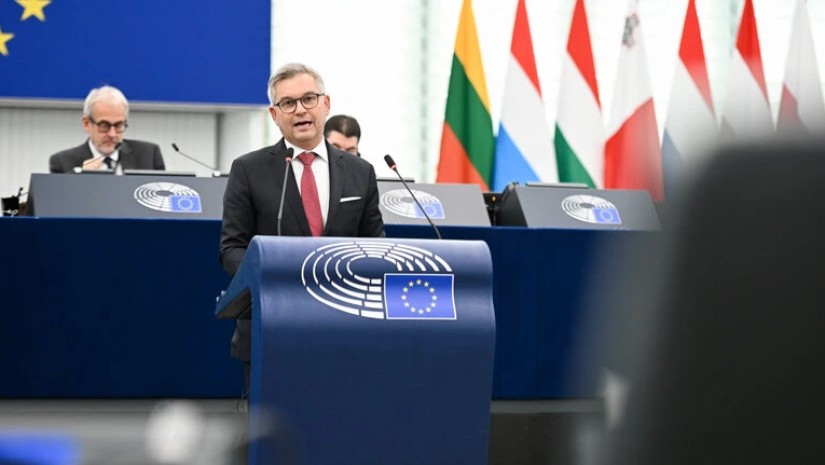

Magnus Brunner, European Commissioner for Internal Affairs and Migration in the European Parliament called on the Georgian government to take action to de-escalate the situation.
“For more than 50 days now, Georgians have been taking to the streets across the country in unprecedented protests, fighting for the democratic future of their nation as part of the European family and for the exercise of their fundamental rights. They have been met with violent repression, intimidation, and detentions,” said Magnus Brunne.
According to the European Commissioner, the Georgian government has recently enacted several amendments to various laws, further restricting fundamental rights and undermining democratic governance.
“Georgia’s progressive democratic decline is indeed alarming. The authorities have recently enacted several amendments to various laws, further restricting fundamental rights and undermining democratic governance. The violence and hate speech directed against peaceful protesters, politicians, and media representatives—along with the reported dismissal of public servants for political reasons and the threats made against Salome Zourabichvili—are completely unacceptable.
Many detainees remain in custody and face potential prison sentences for criminal charges. To this day, not a single representative of the law enforcement agencies has been charged, despite the violent crackdown on protests and serious accusations of torture against detained protesters levelled by the Georgian ombudsperson. Such actions are incompatible with the status of a European Union candidate,” he said.
The European Commissioner called on the Georgian government to take action to de-escalate the situation.
“The EU continues to stand in solidarity with the Georgian people, and we urge the authorities to take swift action to de-escalate tensions. Those unjustly detained must be released, acts of violence must be investigated, and there must be consequences for the law enforcement officials involved in these actions. We also urge the authorities to implement the recommendations outlined in the final OSCE report on the recent elections and to explore all options to restore trust in Georgia’s democratic institutions, always in dialogue with all political forces and representatives of civil society, including the call from Georgian society to consider the possibility of elections.
Last year the European Union adopted several measures in response to Georgia’s continued democratic decline. We downgraded political contacts and halted our assistance to the authorities: €30 million under the European Peace Facility and more than €121 million in direct assistance to the government. At the same time, we continue to stand with civil society organizations and independent media. €8.5 million has already been reallocated to them, and we are also ready to reallocate additional funds to communication activities, as we need to step up our response to disinformation. The European Council decided to effectively hold Georgia’s accession process.
In December 2024, the leaders reiterated the EU’s serious concerns regarding the actions of the Georgian government and its decision to suspend the country’s EU accession process until 2028. The European Council underscored its readiness to support the Georgian people’s European aspirations, provided that the Georgian authorities reverse their course of action. Regrettably, the authorities have not reversed this course.
At the December Foreign Affairs Council, member states broadly agreed to begin the process of halting the visa-free regime for Georgian diplomatic and service passport holders. The Commission swiftly prepared a proposal last December, and the respective council decision should be adopted by the end of January. This decision will send a clear political message that we are holding the authorities accountable. Last year, the Foreign Affairs Council also held its first discussion on the potential adoption of sanctions against individuals responsible for the disproportionate use of force against protesters.
At the upcoming Foreign Affairs Council on January 27, discussions among member states regarding Georgia will continue. We have also closely followed the discussions in this House and the resolutions passed with an overwhelming majority. We remain open to considering further measures in light of the developments in Georgia,” he said.