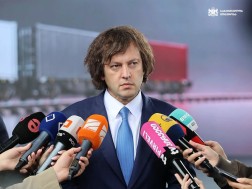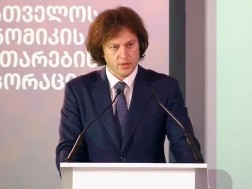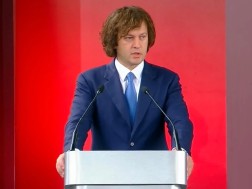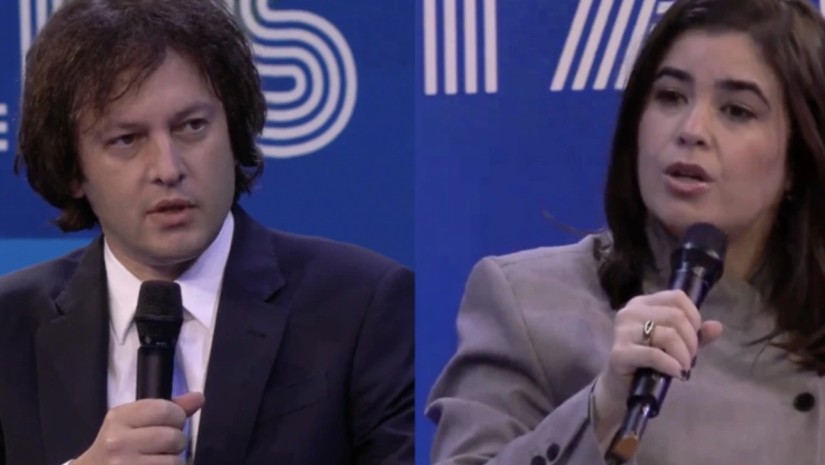

Georgian Prime Minister Irakli Kobakhidze faced a series of challenging questions about Georgia’s European Union membership ambitions, the government’s decision to suspend EU accession talks until 2028, and its strained relations with Brussels during a debate at the EU Enlargement Summit in Brussels, organized by Euronews.
The interviewer repeatedly questioned why the ruling Georgian Dream party wanted to pursue EU membership while having decided in November 2024 to halt the country’s EU accession negotiations until 2028.
“You have it in your Constitution that this is your aspiration and that you want to join the European Union. Yet, in 2024, you decided to suspend accession negotiations just weeks after the European Commission published a report that could arguably be described as devastating for your country,” the interviewer said.
The interviewer also challenged Kobakhidze’s decision to attend the summit and participate in discussions on EU accession despite his government’s decision to suspend the process.
In response, Kobakhidze referred to the EU’s 2022 decision not to grant Georgia candidate status at the time. He claimed that the decision had been used by “interested parties,” referring to the opposition, to organize a revolution, but that they had ultimately failed because Georgia later obtained candidate status.
Asked again why his government had suspended accession talks, Kobakhidze argued that the European Commission had already halted political dialogue with Georgia in June 2024, before his government announced its decision.
“We explained that if the European Commission decided to open negotiations with Georgia, we would immediately engage. But ultimately, it was not us; it was the European Commission that decided to suspend political dialogue with Georgia in June 2024. This happened before we made our announcement regarding negotiations,” Kobakhidze said.
When asked whether the government's decision was a response to the European Commission's critical assessment of Georgia, the prime minister answered: “Yes, it was in response to the European Commission’s general and unfair policy.”
Addressing relations between Georgia and the EU, Kobakhidze claimed that Georgian society maintained a high level of trust in the European Union as an institution but had very little confidence in the European Commission. He also asserted that public trust in the ruling Georgian Dream party remained high.
Throughout the discussion, the interviewer repeatedly pressed Kobakhidze on how his government intended to restore cooperation with Brussels, particularly in light of the European Commission’s criticism of Georgia’s democratic trajectory.
The interviewer cited the Commission’s assessment that the Georgian authorities continued to declare EU integration a key priority while engaging in consistently hostile, anti-European rhetoric. The report also stated that changes to the legislative framework had undermined the independence and integrity of the judiciary.
“I find it difficult to see how you can sit here and say that you want to reopen dialogue when these are two completely different worlds,” the interviewer told Kobakhidze.
When the prime minister dismissed the report and referred to European Commission officials as “bureaucrats,” the interviewer challenged him directly: “Is this 90-page report false?”
Kobakhidze repeatedly insisted that the Georgian government wanted dialogue with Western partners. However, the interviewer questioned how meaningful discussions could take place if Georgian Dream was unwilling to address the recommendations outlined in the report.
“What are you prepared to do now? Because, as things stand, you can hold as many debates as you want. They are telling you: ‘This is our assessment. This year’s report will not fundamentally change.’ What are you prepared to do to restore genuine dialogue?” the interviewer asked.
Kobakhidze again criticized European Commission officials, EU member state leaders and the Venice Commission, describing them as political actors and bureaucrats.
The interviewer then posed one of the most pointed questions of the debate:
“If the Venice Commission is also made up of European bureaucrats, the European Commission is made up of bureaucrats, and the leaders of all 27 member states are part of this bureaucracy, Mr. Prime Minister, why do you want to join this European Union at all?”
Kobakhidze responded: “Because we are optimistic that they will change.”
The discussion also focused on the absence of a concrete roadmap for restoring Georgia’s EU integration process. After repeatedly asking what specific steps the government intended to take, the interviewer challenged Kobakhidze to outline an actual plan.
“I just want to understand: What is your plan? Because when I heard you were coming here, I thought, ‘Okay, he will have a real plan and make a statement that he has returned to Brussels to say: Let’s discuss A, B, C and D.’ What are A, B, C and D?” the interviewer asked.
Kobakhidze replied: “Yes, A, B, C and D are talk, talk, talk and talk. You cannot develop a plan if you do not talk.”
Another key issue was the so-called Foreign Influence Transparency Law, commonly referred to as the foreign agents law, which has been a major source of tension between Tbilisi and Brussels.
Asked whether the Georgian Dream government was prepared to withdraw the legislation, Kobakhidze rejected the possibility, arguing that such a demand would violate Georgia’s sovereignty.
“Suspending the law is not a proposal. It is a violation of the principle of sovereignty. We have a parliament of Georgia that adopted legislation - legislation that fully complies with international standards. When someone says that the Parliament of Georgia, a sovereign body, must suspend its legislation, this contradicts the principle of sovereignty. This is what we are talking about. This attitude must change,” the prime minister said.
The exchange highlighted the continuing divide between the Georgian government and European institutions over democratic standards, judicial independence, controversial legislation and the future of Georgia’s EU accession process.